The Seljuk Han of Anatolia
Inscriptions
Many hans have carved dedication plaques (in Turkish, kitabesi) which provide valuable primary-source information about the hans.
The decoration of Seljuk buildings was focused their portals, which contained the majority of decoration. An inscription plaque was generally located above the main door, be it on city walls, hospitals, mosques, medreses or hans. Many hans have carved inscription plaques (in Turkish, kitabesi) which provide valuable primary-source information about the hans used for the dating of hans.
Visible to all entering the han, the inscriptions offered a golden opportunity to announce the generosity of the donor or the might of the reigning sultan.
These inscription plaques are always located over han doors, in one of 4 places:
-over the
door of the main portal
-over the door of the mosque
-over the door leading to the courtyard
-over the door of the covered section
The space above the entrance door is usually flat, and constitutes a sort of tympanum on which the inscription plaque was placed. The inscriptions are carved on a separate piece of flat stone, of better quality than the surrounding building stone. These stones were set recessed, with the depth providing the illusion that the plaques are framed. Inscriptions plaques are often carved in marble, which was the preferred stone for all inscription plaques on Seljuk monuments; however limestone was also frequently used.
The inscriptions were always written in Arabic, and in general in the nakshi or sulus style of cursive favored by the Seljuks. Sometimes the writing could have been highlighted in red paint. The Hekim Han inscription, written in Rosetta Stone-style fashion in three different languages, is a singular inscription. There were of 3-7 lines of text. They included different types of information, which varied for each han, and not all of the types of information were included on each inscription. The inscription follows a hierarchy of information:
-Names, titles and genealogy of the patron if of the royal family, often followed by boastful epithets (Pazar Han). The name of the patron is sometimes mentioned at the same time as that of the reigning sultan.
-Date (not always indicated, as the mention of the reigning sultan was considered sufficient; (“Built in the time of Sultan…in the year…”). The dates are given in the day and month
-Benediction for the sultan or patron. As a general rule, the inscriptions of Alaeddin Keykubad employed standard titles derived from those of the Great Seljuks, whereas his son Giyaseddin Keyhüsrev used a colorful and more boastful approach to describing himself.
-If the name of the architect is mentioned, it is given at the end of the inscription. In only 2 cases (and both in relatively insignificant monuments) is the architect’s name given.
In certain cases (Kadin, Ertokuş, Çardak, Ak, Sadeddin), the inscription starts out with a mention of the “Sultanship” with no clear and precise name given.
There are several hans for which the sultan and patron are both clearly indicated (both Sultan Hans, Incir, Evdir, Şarafsa and Alara).
Some curious facts can be gleaned, such as the name of the Christian patron of the Hekim Han, but little information is provided concerning the profiles of the lesser-known patrons.
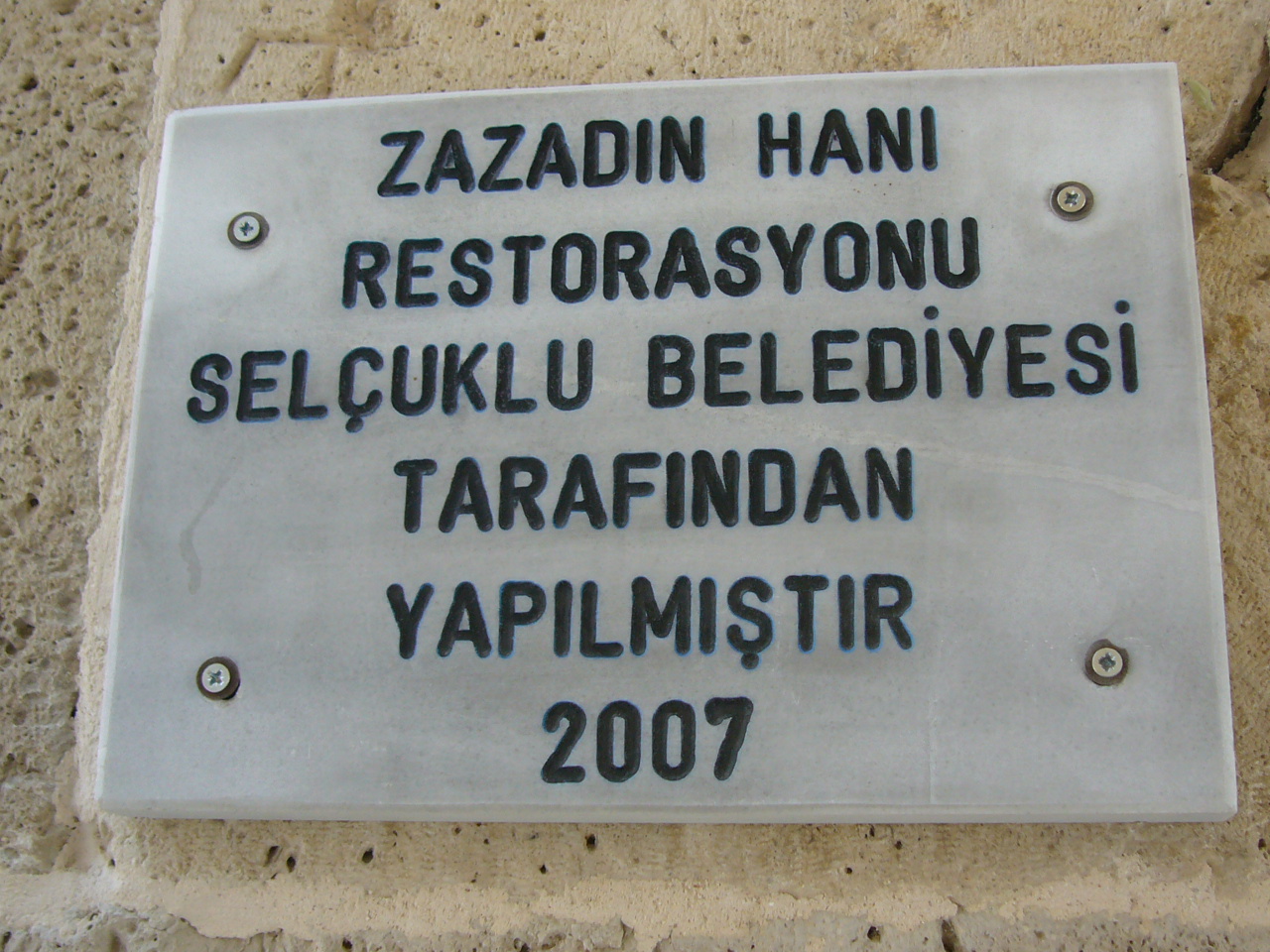
Rarely is a date other than the building date listed, except for references to the restoration of the Sultan Han Aksaray portal and perhaps the restoration of the courtyard portal of Incir Han. A modern day restoration plaque was installed in the Zazadin Han to commemorate the 2007 renovation.
The inscriptions are of unequal quality, with the larger hans generally having a finer level of workmanship. This is understandable as the scale and budget of these hans attracted the best master artisans. In addition, there are differences in epigraphic quality in inscriptions, with spelling or grammar mistakes noted. These differences can be due to many issues. We really don’t know how these inscriptions were made. Who originally wrote the texts for the carver to copy: was it a local imam or a court chancery scribe, and what was his level of literacy? The language of the court was Persian, and not Arabic, so errors could have possible. The texts may have been recopied before going out into the field for execution, again, a potential opportunity for error. We also can wonder what slips of hammer occurred when the carver transferred a written text on paper to stone – pen on paper is not chisel on stone. We can also ask if the stone carver was even literate, or if so, how literate, and could read Arabic, for a stone carver is not in the same educated class as a court scribe. It is also known that many stone carvers were Armenian Christians, who may or may not have been literate in Arabic. Lastly, it is certainly a challenge for modern scholars to tackle the translations of texts belonging to an era so far gone, which has led at times to varying interpretations of the texts.
It is interesting to note that the word caravansarai was never written on the inscription plaques, only the word “han” or sometimes “ribat” The Turks did not use the Persian word “caravansarai” (meaning “house of the caravan”), but rather han. In contrast, the term “caravanserai” was used in texts written in Persian by such writers as Ibni Bibi, Eflaki and Aksarayi (to note: the Seljuks used Persian in official administrative documents but Arabic for inscriptions). The word caravansaray was used by the Italian Pegolotti in his Practica della mercatura (Merchants Guidebook), written in 1339-40, and this word was then picked up by the West.
One can wonder how many of the merchants passing through these doors and lifting their eyes upwards were able to read the inscriptions over the door: Arabic was not the first language of the people of Anatolia (comprised of Greek farmers, Armenian craftsmen and Turkmen shepherds), and certainly not all of the foreign merchants coming to the Anatolian lands could read it. However, it is certain that they could recognize that Islam and the Arabic language were responsible for the fine quarters they were about to enjoy.
Inscription plaques provide the following information:
1) Hans for which we know the Sultan was the
patron (the so-called "Sultan Hans"):
2) Hans in which the Sultan’s reign is named : (“Built in the reign of …..”):
Most of the hans built by sultans and mentioned in written sources have not survived to the present times. The remaining inscriptions indicate that the majority of the hans were constructed by Alaeddin Keykubad I, by his brother Izzeddin Keykavus I and by his son Giyaseddin Keyhüsrev II (1236-46).
Sultan Giyaseddin
Keyhüsrev I (1192-96; 1204-1211)
Kuruçeşme
Dokuz Derbent
Kiziloren
Sultan Izzeddin
Keykavus I (1211-1220)
Hekim (covered section)
Evdir (as patron)
Sultan Alaeddin
Keykubad I (1220-1237)
Çardak
Hekim (courtyard)
Sultan Han Aksaray (as patron)
Sultan Han Kayseri (as patron)
Zazadin (covered section)
Karatay
Alara (as patron)
Ağzıkara (covered section)
Sultan Giyaseddin
Keyhüsrev II (1237-46)
Ağzıkara (courtyard)
Zazadin (courtyard)
Incir (as patron)
Karatay (courtyard)
Hatun
Kirkgöz
Cimcimli Sultan Han
Çekereksu
Şarafsa (as patron)
Sultan Giyaseddin
Keyhüsrev III (1266-83)
Durak Han
Kesikköprü Han
Çay Han
3) Hans with a clearly-indicated
construction date:
|
1205-6 |
|
|
1207-10 |
|
|
1210 |
|
|
1215-1220 |
|
|
1218-20 |
|
|
1223 |
|
|
1223 |
|
|
1229 |
|
|
1230 |
|
|
1231-2 |
|
|
1231 |
Ağzıkara (covered section) |
|
1232 |
|
|
1235 |
Zazadın (covered section) |
|
1237 |
Ağzıkara Han (covered section) |
|
1237 |
Zazadin (courtyard) |
|
1238-9 |
|
|
1238-9 |
|
|
1234 |
|
|
1240 |
|
|
1240-1 |
|
|
1237-46 |
|
|
1237-46 |
|
|
1249-50 |
|
|
1253-54 |
|
|
1266 |
|
|
1268 |
|
|
1278 |
Sultan Han Aksaray (restoration) |
|
1278-9 |
4) Hans where the construction date can be inferred from other inscription indications:
|
1220 |
Hekim Han (mentions Izzeddin Keykavus I) |
|
1220-30 |
|
|
1238-46 |
Tahtoba (Mahperi Hatun) |
|
1238-46 |
Ibipse (Mahperi Hatun) |
|
1246-9 |
|
|
1245-50 |
5) Hans where the name of the patron responsible for the construction of the han is mentioned (26 in total):
-Government dignitaries:
Pervane Muineddin Suleyman bin Ali
-Lesser-known dignitaries in service to the government:
Emir Emir Kutluğ bin Muhammed (Emir Kandemir) (Kandemir Kuruçeşme)
Esededdin (or Izzeddin) Ayaz bin Abdullah el-Sahabi (Çardak)
Nasr ad-Din Hasan ibn Ibrahim (Eşhab-i Kehf)
Vizier Nureddin Cebrail Bin Caca (Kesikköprü)
Seraceddin Ahmed Kerimeddin bin El Hasan (restoration of the Sultan Han Aksaray)
-Charitable institutions:
-Private patrons:
6) Hans where the name of the architect is provided:
-Haci Osman ibn Abderahman (Dokuzun Derbent)
-Gevherbaş bin Abdullah (Durağan)
-Sadeddin Köpek (Zazadın): It is possible that Sadeddin Köpek, known as an architect, may have
directed the work at the han he commissioned.
-Ogul Bey bin Mehmed (Çay): Two other names are given which are believed to be those
of
the architects.