The
Seljuk Han of Anatolia
The
Seljuk Han of Anatolia
The
Seljuk Han of Anatolia
ALARA HAN
The Alara Han displays a highly complicated plan, unlike any other Seljuk han. It may have been built to serve the special needs of the sultan on his trips down south from Konya to his winter quarters in Alanya. Mysterious mason "runes" and "crying" lions lamp fixtures, as well as the decorated mosque, are distinctive features. Set in stunning countryside, it is a magnificent example in terms of its construction technique, details, dimensions and proportions.
DISTRICT
07 ANTALYA
|
photo by Ibrahim Divarci; used by permission |
|
Eravşar, 2017. p. 526; photo I. Dıvarcı |
|
Eravşar, 2017. p. 528; photo I. Dıvarcı |
|
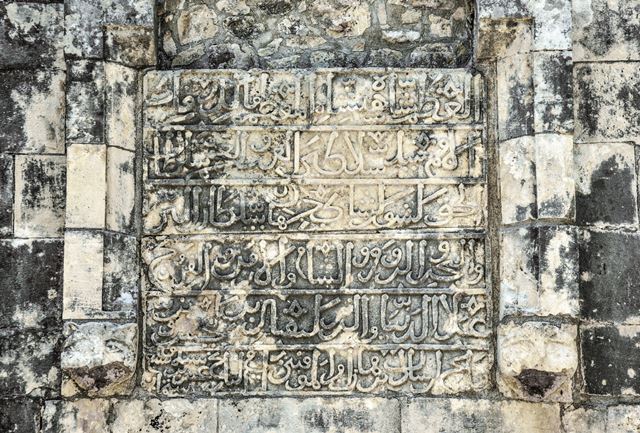
architrave and inscription plaque |
|
Eravşar, 2017. p. 528; photo I. Dıvarcı |
|
|
|
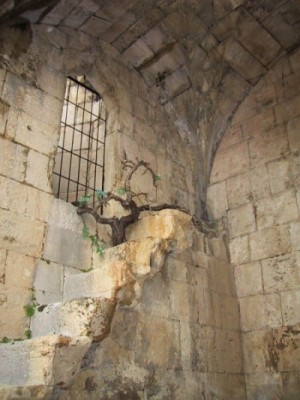
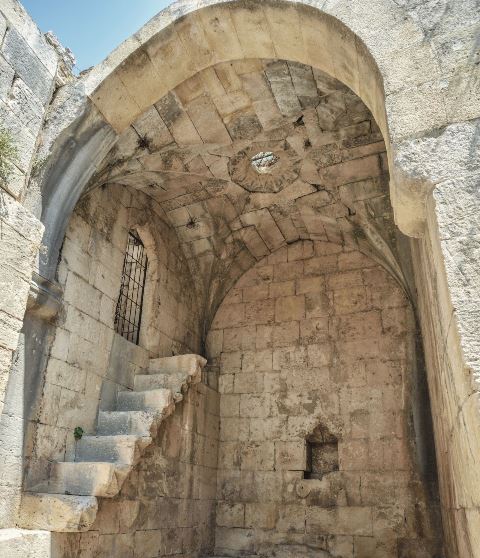
steps to roof in hammam room |
|
photo by Ibrahim Divarci; used by permission |
|
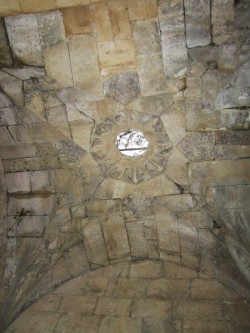
skyhole/sundial in hammam room |
|
|
|
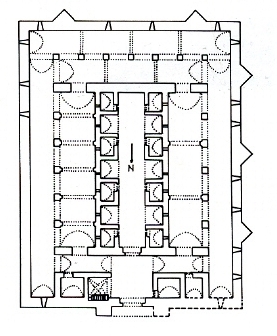
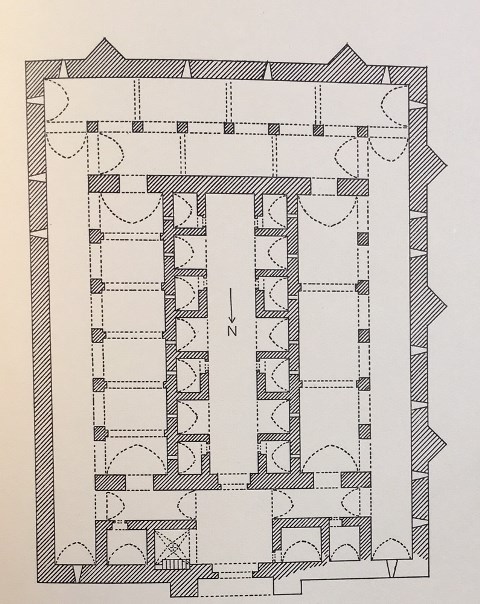
plan drawn by Erdmann |
|
inner door leading to central corridor |
|
Eravşar, 2017. p. 534; photo I. Dıvarcı |
|
first outer ring, southern side |
|
first outer ring, eastern side |
|
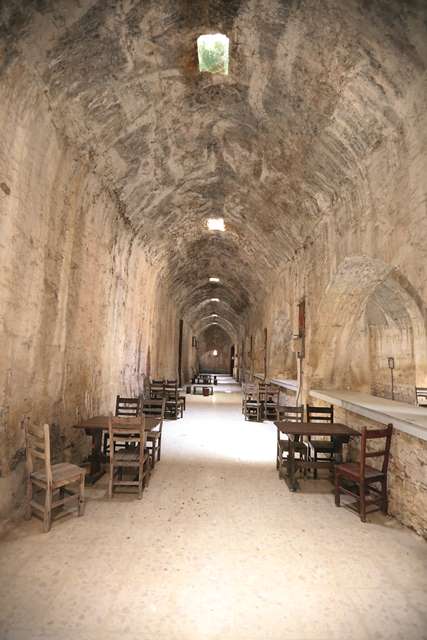
second outer ring, southern side, showing low wall used as sleeping banquette |
|
outermost stable ring Eravşar, 2017. p. 533; photo I. Dıvarcı |
|
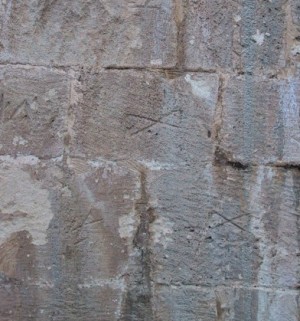
Mason marks |
|
Eravşar, 2017. p. 353; photo I. Dıvarcı |
|
photo by Ibrahim Divarci; used by permission |
LOCATION
36.692262, 31.723856
This han is located the Alanya-Antalya
road, approximately 30 miles southeast of Manavgat, 5km from the village of
Okurcalar, 1.5 km to the right of the road. It is accessible by a side road
leading north 10 miles. It is located approximately 10 miles from the
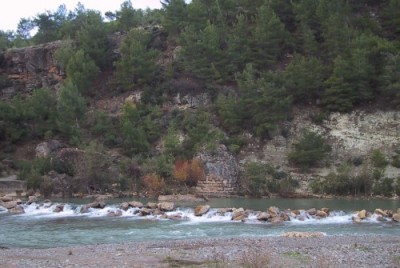
Mediterranean Sea at the mouth of the Alara River, in a serene gorge setting.
The han sits on the left bank of the fast-running waters of the Alara River at
the site where it breaks free from the Taurus mountains to hit the alluvial
plane. The ruins of a three arched bridge are in front of the han. Another
ruined bridge farther along, dating this time from the Seljuk period, was
demolished during a flood caused by torrential rains in 2007.
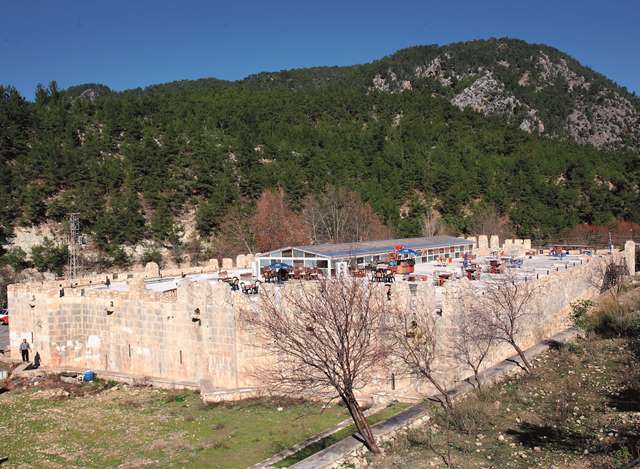
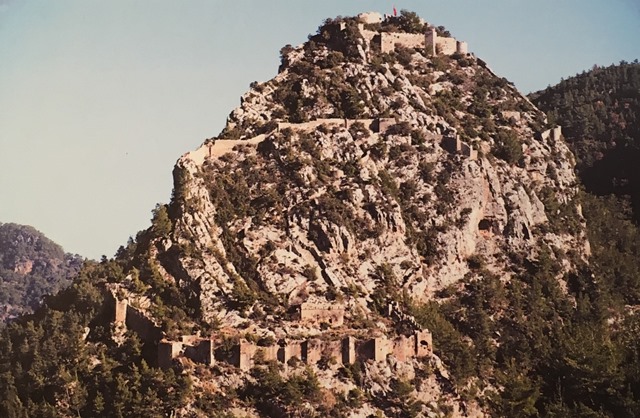
The han lies in the shadow of the Alara Castle, high up on an isolated rock crag to the east. The Alara Castle, which holds an important place in Seljuk art history, was previously used by the Byzantines before the time of the Cilician Kingdom of Armenia. It is mentioned in sources as having been restored by Sultan Alaeddin Keykubad I. The story of the conquest of the castle by Alaeddin Keykubad is related in the chronicle of the Seljuk court historian Ibni-Bibi. This castle is currently being excavated by Prof. Dr. Osman Eravşar, who scrambles up to the top of the steep cliff with the ease of a mountain goat. In an important archeological event, in the 2018 excavation season, Dr. Eravşar discovered a Seljuk-era bazaar in the Alanya Castle, the only Seljuk bazaar that has come to light.
The han is situated on both the east-west Antalya-Alanya road and the northern road towards Konya. It is the second staging post on the journey to Konya from Alanya. This road, which went from the Mediterranean region to Central Anatolia, was an ancient road used from earliest time. Historical records indicate that the Alara River was used as an inner port for the shipping trade in the Bronze Age.
Alara is thus the name of the river, the castle and the han.
NAMES
The inscription of the han, bearing a date of 1231, makes no reference to the name of the han. It appears that the han takes its name from the river, which was a name first encountered in texts relating the history of the Armenian Kingdom of Cilicia.
The historian Aqsarayi mentions that Baba Ilyas Khorasani, aka "Baba Resul", the Turkmen rebel preacher/ruler, took refuge in this han during the rebellion (approximately 1240).
The han has been mentioned by several foreign travelers, including O. Von Richter (1816), Tschihatscheff (1867), Lanckronski (1890), and the team of Heberdey and Wilhelm (1891).
This han has been researched over the years by F. Erten, S. Lloyd and Rice, Erdmann and most recently by Aysil Tükel Yavuz, who uses the Alara Han to illustrate her "Shelter" typology.
DATE
1231 (dated by inscription)
It was built in the same year as the Aksaray Sultan Han and the Evdir Han.
The Han was built in the period after the Sultan conquered Alanya and 1221 and began to use the city as his winter headquarters. He married the daughter of Kyr Vart, the Lord of Alanya, and often traveled between Konya and Alanya. This han must have been designed a resting spot for him and his royal retinue during his travels.
INSCRIPTION
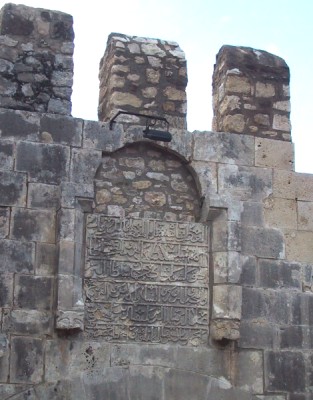
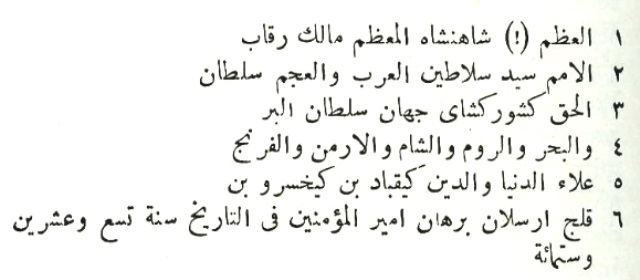
The inscription placed on the circular board above the entry crown door has been lost. There is a square inscription below it, but it contains only the lower part of the inscription. The six lines of Arabic text are written in Seljuk naskh style calligraphy and provide the date and name of the Sultan. It reads as follows:
"...the most august (?)...the exalted king of kings, the master of the necks of the nations, the master of the sultans of the Arabs and the Persians, the sultan of justice, the conqueror of the cities, regions, of the universe, the sultan of the lands and the seas of the Greeks, Syria, the Armenians and the Franks, Ala'ud-dunya wad-din Kaykubad son of Kaykhusrev son of Qilij Arslan, the Eminence of the Commander of the Faithful, on the date of the year 629" (1231).
This inscription repeats the same mention of the qualification of "Sultan of
Lands and Seas" that appears on the inscription of the Kizil Küle in Alanya.
The Sultan conquered the Alara castle, and soon after built in its citadel a
two-domed bathhouse with tiled walls and painted imagery on the dome. It is
assumed he ordered the construction of the han soon after his conquest of the
citadel.
REIGN OF
Alaeddin Keykubad I
PATRON
Although it is not directly stated in the
inscription, this appears to be a sultan han, commissioned directly by Alaeddin
Keykubad I himself. According to the building inscription, the han was built
during the reign of Alaeddin Keykubad, in Hijri 629 (1231 A.D.). However, the
flowery language and praise concerning the Sultan indicate that the han
must have been built by him, and the fact that it is the same as the inscription
on the Kizil Kule lends credence to this.
BUILDING TYPE
Concentric plan (CON)
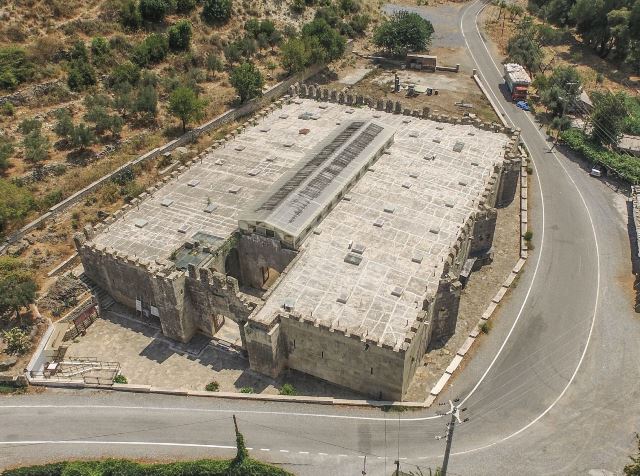
This han possesses one of the most complex and original plans of any han ever built, and has intrigued scholars past and present. The Alara Han is one of the few examples of hans belonging to the group of concentric hans of Anatolian Seljuk architecture.
This han offers an unusual and ingenious variant to the normal plan typology. This han displays a plan like non other. In short, this han is built around a central core "courtyard" surrounded by two rings. It is assumed that the inner ring was reserved for travelers and goods, and the outer ring for services and animal stabling. The plan can be summarized as:
1) inner courtyard with rooms
2) first ring: iwan spaces
3) second ring: stable areas
In the middle of the han is a long narrow “courtyard” covered with a row of cross vaults and a square pool at the center. This courtyard is surrounded on the long east and west sides by a series of small rooms alternating with iwans. These rooms give access to the second ring, comprised of a series of large iwan spaces on three sides, all with a different orientation. This first ring is flanked on the long east and west sides with long stable sections which form the second ring, and the southern side has another group of spaces arranged horizontally. Indeed, it is a complicated and highly-developed plan.
Despite the fact that this is probably a royal commission by Sultan Alaeddin Keykubad, this han is very different than his other two Sultan hans. It is built with an unusual and rare plan concept, although it was built in the same year as the Aksaray Sultan Han. This han is classed in a distinctive group, called the "concentrically-planned" hans. The Mirçinge, Afşin Eshab-i Keyf, Yer, Mama Hatun, Sevserek Hans are the hans most similar in plan to the Alara Han, but none display the highly-developed design of the Alara Han.
The researcher A.T. Yavuz has extensively studied the concentric plan type. She believes that similar examples existed in the architecture of the Sassanid era in the 2nd century, the most significant example being the Dschurdchan Han in Iran. She states that this third category was invented according to climatic conditions which affected the needs for shelter, and, as a result, the covered and service areas were separated from each other in order to make the han more comfortable. However, it is not known why more of this type of han were not built, nor what predicated the choice to build with this plan. Yavuz believes that these hans were designed in relation to the climatic conditions of the region, in order to make them more comfortable, yet the Alara Han is built in a very hot climate and the Mirçinge in a very cold one. No exact information is available as to whether the courtyard of the interior section of the Alara Han was covered or not (in view of the climate, it probably was not). The plan of the Alara Han most certainly developed from the han plan consisting of a covered section with three naves, when the arches of the side naves were closed in, such is as is seen at the Çakalli, Burma and Ibrahim Shah Hans.
DESCRIPTION
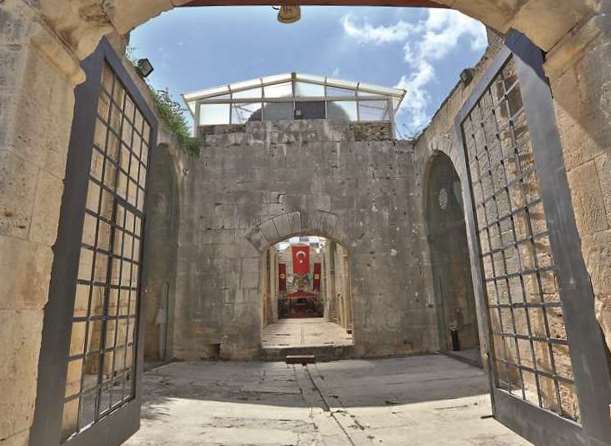
The building is oriented north-south. The entrance is on the north side of the courtyard, on axis with the interior courtyard.
Main portal
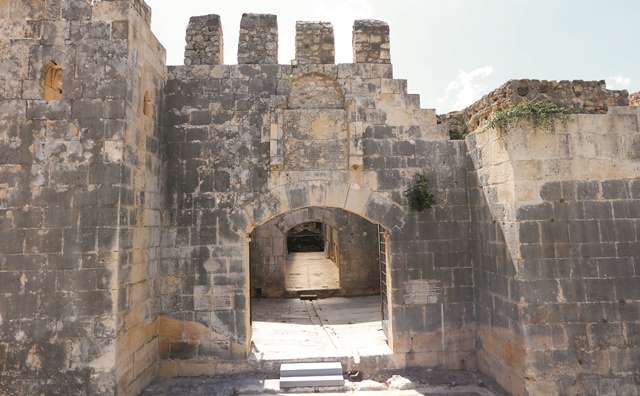
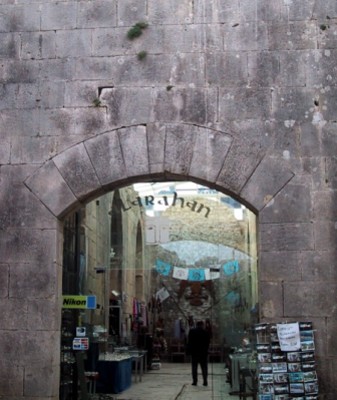
The main portal is 3.5 m wide and has a flattened arch, and is flanked by two small square towers (the one to the right has collapsed). The entrance facade terminates in chunky crenellations.
A square inscription plaque is located over the door, above which is an arched inscription board, now empty. The top part of the inscription, believed to have originally consisted of two parts, has been lost and its area is now empty. The inscription is surrounded on both sides by a frame sitting above consoles which have a lion’s head below them. The frame ends without any connection above. There is a square inscription below it, but it contains only the lower part of the inscription. The six lines of Arabic text are written in Seljuk naskh style calligraphy and provide the date and name of the Sultan. The inscription is framed in a broad stone architrave, which boastfully states that Alaeddin Keykubad is the "Master of Syria and Anatolia, Sultan of the Franks and the Armenians". The side elements of the frame rest upon stone corbels, carved in the form of lion's heads.
Entrance corridor and side chambers
After passing through the main door, the visitor enters an uncovered entrance vestibule, which forms a square mini-courtyard. It comprises two square rooms on each side and one lateral room in front of them. A large number of stones with quarrymen's marks are found in this area. The rooms and iwans were covered with pointed vaults. The rooms surrounding this entrance were the service areas used by the various attendants of the han.
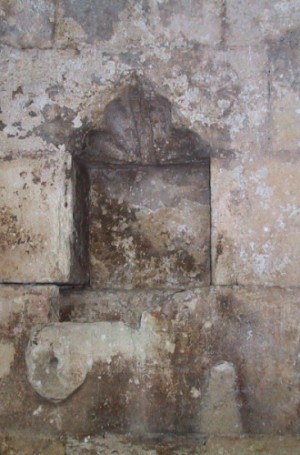
Traditionally, the room to the left upon entering has been considered to be the mosque, but in reality was probably a hamam and/or a fountain. It was given particular attention by the architect. It possesses a quadripartite vault with projecting groins and an octagonal oculus in the middle. This sky hole probably also served as a sundial. The first square room on the east side has a star vault and opens directly onto the entrance area. A series of stone steps leads to the upper section of the han. There is a recessed fountain niche in the southern side wall. This niche was carved from a single piece of stone, with a pattern of arch sections. Broken pieces and various other parts have been found below this niche, but their function has not yet been determined.
A staircase of seven steps against the north wall of the iwan leads to the roof. Traces indicated that there was a catwalk over the main facade. A terracotta water drainage pipe leading out of the facade wall was discovered during the restoration of the han, which again suggests that this room was used as a hammam.
The first room to the west (right) right after the door possesses a mihrab niche in the west wall (not shown on Seton Lloyd's plan), and thus can be assumed to be the mosque. The arch of the mihrab niche was visible before the restoration. The other two rooms on each side were probably used as administrative offices or storage, as they are today. There are two carved lion's head lamps located in the corridor leading to the right side.
Between these square spaces and the interior courtyard section are two corridor-like spaces in front of each side of the entrance service rooms. The hallways are covered with low, pointed arches and give access to the stable areas at the outermost ring of the han. Similar openings are located in the southern part of the corridor, and give access to the space on either side of the courtyard rooms.
Central Corridor/Courtyard
The entrance
leads past the iwan directly into the long and narrow open courtyard, so narrow,
in fact, that it resembles more a corridor than a courtyard. A small drainage
gulley runs down the middle of the courtyard and connects to the exterior via an
opening below the entrance door.
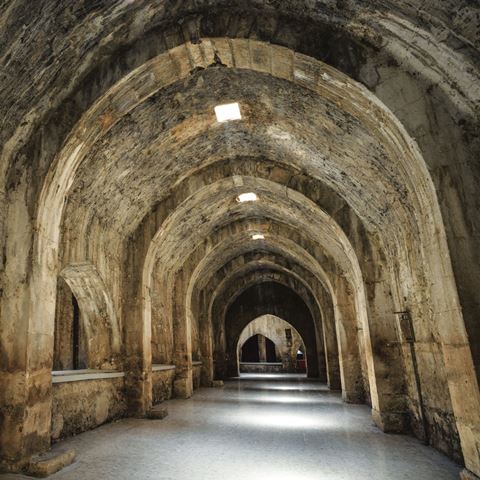
There is a symmetrical row of small vaulted rooms on each side of the corridor, separated by small open iwans (4 rooms and 3 iwans per side).
Historians dispute the original use of this corridor and its side rooms. Although not a service courtyard in the traditional sense, it is difficult to imagine that animals circulated here and that goods were loaded and loaded in this tight and narrow space. The rooms probably served as accommodations for travelers or for storage of more valuable treasury items and the corridor gave access to them, much like a modern hotel corridor. The flexibility of closed and open rooms around the periphery of the corridor offered the travelers a solution to changes in weather. There is no exact information available as to whether the courtyard of the interior section of the Alara Han was covered or not. Currently, it is covered with a steel and plexiglass covering. However, some wall traces indicate that it could have been covered by a barrel vault. The central courtyard of the Mirçinge Han, another concentric plan han, is covered by a huge vault, but generalizations cannot be drawn as the climate in that region is quite cold in the winter. As anyone who has spent any time in the Alara/Alanya area can attest, it is very, very hot here, so enclosing the corridor would have rendered those interior spaces unbearable, as well as very dark.
Each courtyard room had a small window slit in the rear wall which gave out onto the side concentric ring. As these windows were not created for light and ventilation, they were most probably "peep holes" onto the side ring. In this fashion, the travelers in the central corridor could use them to keep watch on their animals and goods stored in the next ring.
First outer rings: Accommodation areas for travelers
The central corridor and its rooms are ringed by two more levels of spaces. The first inner rings are different on each side. The first ring served as accommodations for the travelers and the second ring for animals.
The first ring on the west side is distinctive due to the 16 oil lamps in the shape of lion's heads that are located at the base of each of the 6 outer pillars and on either side of the peepholes. Waist-high walls are provided on the outer side, which were most probably used as sleeping banquettes for the guards and keepers. These low walls also separated the space from the next outer ring. This section is covered by a barrel vault with 5 small square light oculi in the ceiling.
On the eastern side, the space is much less elaborate. There are no lion's head lamps here. Once again, the space is covered with a barrel vault, and a raised wall separates the space from the outer ring (probably used as sleeping banquettes). The rings of both sides are connected at the rear by a barrel-vaulted corridor with 7 supporting pillars. The southern ends of these rings open onto a space which connects to the outer stable area.
Second outer rings: stables
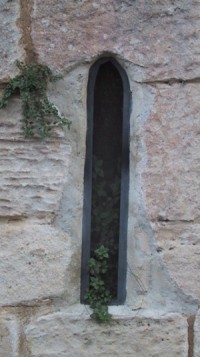
These accommodation rooms are ringed by a long undecorated corridor on each side, covered by a barrel vault. The western wall is pierced with 7 window slits; the outer wall of the eastern wall has 3 slit openings at the southern end. The southern rear wall has four slit openings. These spaces were used for the stabling area.
Use program
T.P. Duggan believes that this han was not used for accommodations of travelers, but was rather a permanent Seljuk state archive and treasury building. The elaborate decoration of stone lions' heads in an area destined for animals, the costly stone floor, the presence of candlesticks and oil lamps in a straw-laden area indeed make him question the attribution by Seton Lloyd of the second concentric ring as the stabling area. Although Duggan's argument is valid, this han was probably used as a commercial staging post, in view of the presence of a mosque. It can be considered that precious goods and travelers probably stayed in the inner corridor cells, commercial goods were stored in the first concentric ring, and the animals were stabled in the second outer ring.
A second hypothesis states that this han was built as a ribat for the troops of the sultan during his trips between Konya and Alanya. This han was most certainly used by Alaeddin himself and his retinue on their voyages between Konya and Alanya. The segregated plan offered considerable attention to comfort as befitted their station.
BUILDING MATERIALS
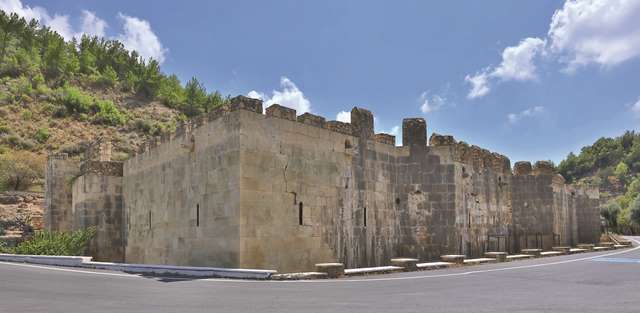
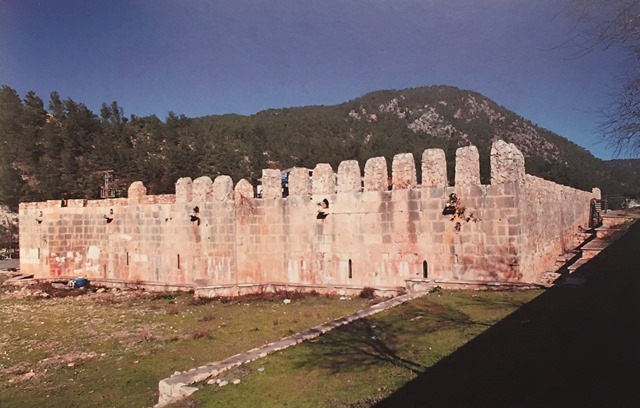
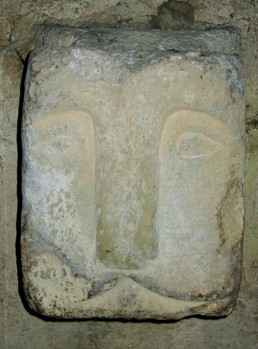
The han is built of carefully-joined, finely-hewn limestone blocks, with walls 2m thick. Pitch-faced stones can be seen in the vaults of the stable and in certain sections of the walls and platforms. The rubble wall technique was used, which consisted of filling rubble stone and mortar between two sets of cut blocks. Lime mortar was used to bind the stones. No reuse spolia materials were used in the han. Numerous mason marks can be seen on the stone blocks.
EXTERIOR
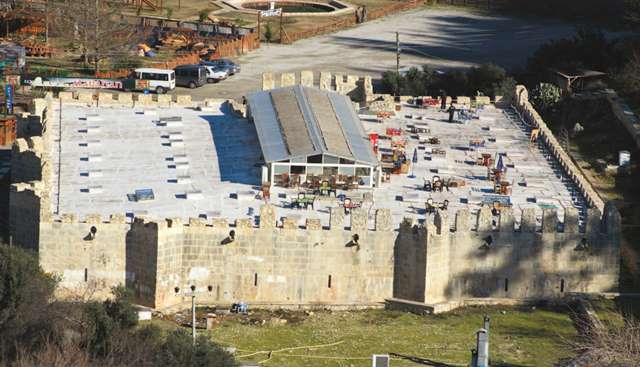
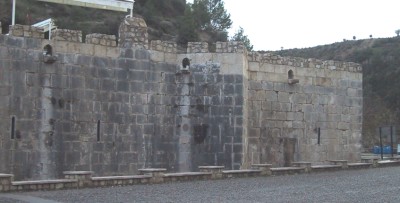
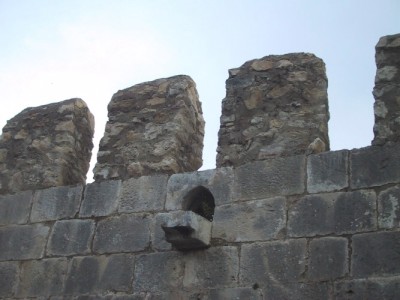
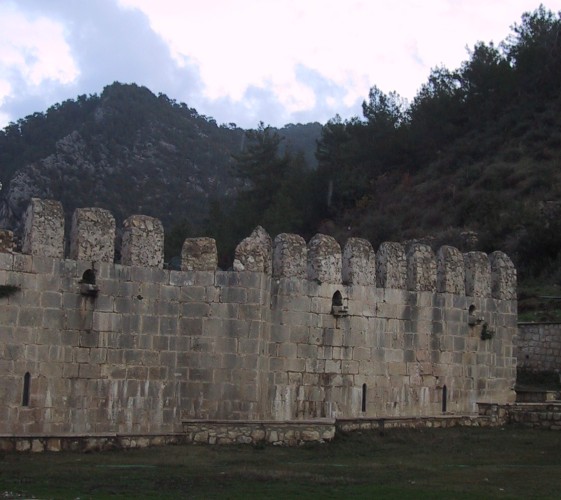
The exterior walls of the han were reinforced by triangular support towers; three on the west side and two on the south side. All the walls, except for the one in the entrance section, were built with turrets with crenellations. Gargoyle water spouts are located between the turrets on the west side.
Bath:
After the recent excavation, a separate bath not far from the main building was discovered on the road connecting the han and the Alara castle. This small bath, mostly in ruins, comprises a single room with an iwan, and may have been built at a later date.
DECORATION
Perhaps the most interesting example of
lion figures used in Seljuk art can be seen in the abstract lion-figure candle
holders of the Alara Han. The lion-head consoles were used to set oil lamps on
for lighting the interior space. Lions are also seen at the Karatay, Incir, Ak and
Cardak Hans. Most hans were lit by small
slit windows in the exterior walls, but here at Alara, the lighting program is
highly developed. The han is decorated throughout with some 79 lion head
sculptures (approx 12" high) that were used as oil feed for oil lamps or
candles. There was a projecting stone at the base of each window of the inner
courtyard hall, also carved in the shape of
a lion's head. These carved figural stones also appear outside the chambers low
on the piers which support the arcading in the stable galleries. The lion was
used as the symbol of the Seljuk power, and is seen on all forms of Seljuk art.
According to a legend of the local folklore, their sad faces are a reflection of
the homesickness felt by the travelers.
These figures have become the
emblem of the han. The famous poem of
Camlibel, Han Walls, certainly conveys this
homesickness with poignancy.
Significant decoration is found in the iwan of the fountain, which includes a hexagonal motif in the center of the square keystone of the star vault above the iwan. This hexagon is surrounded by a triangular motif.
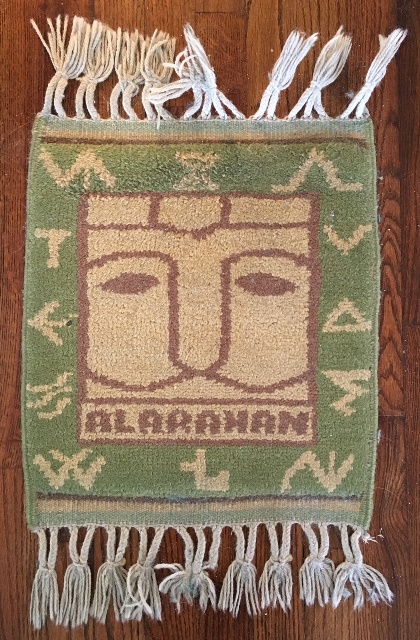
The numerous stonemasons' marks furnish a certain, albeit unintentional, decorative element. Each quarryman "signed" the stones he cut in order to aid the tally for payment. Over the years these marks have been considered as good luck omens and are often replicated in the rugs and embroideries of the region.
Some of the stones on the back wall bear red painted zigzags, which was a decorative element favored by Alaeddin Keykubad, seen on his palace at Aspendos and at the Alanya castle. The only other decoration of the han is the elaborate inscription plaque on the portal.
The mysterious mason "runes" and the "crying" lions confer a distinctive and appealing decorative signature.
DIMENSIONS
34.5 x 45 m
Overall area: 2,000 m2
STATE OF CONSERVATION, CURRENT USE
The modern sign outside the han states that it was used as a dervish lodge in post-Seljuk times, and was abandoned during the mid-19th century. A local shopkeeper remembers playing in the han as a child, and affirms that the central corridor was covered at that time [sic] which is contrary to what Seton Lloyd recorded in 1958.
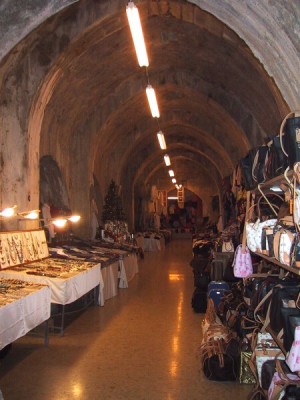
This han was restored in 1998-2000 by the architectural firm PUSAT in return for rental of the han for 49 years by the Foundations Directorate of the Turkish Ministry of Tourism. It is currently in use as a tourism facility. The han houses shops and bazaar-like stalls in the inner corridor and in the first ring to the south. Some changes were made to the han to adapt it to this purpose. The courtyard in the center of the covered section was enclosed by glass on the outside.
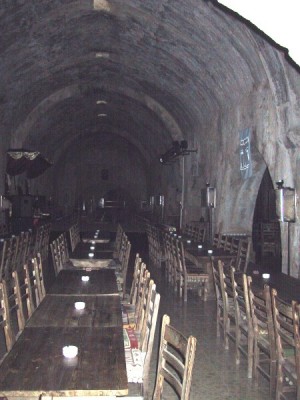
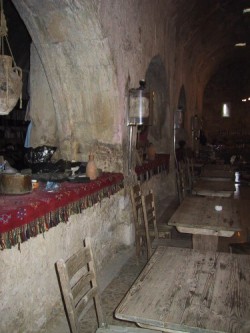
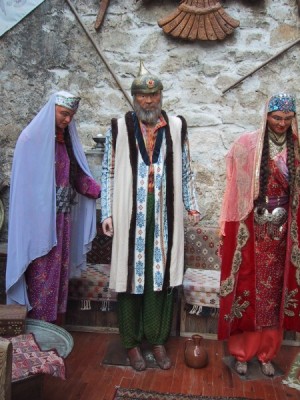
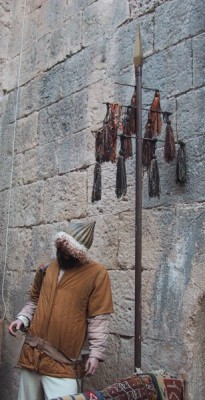
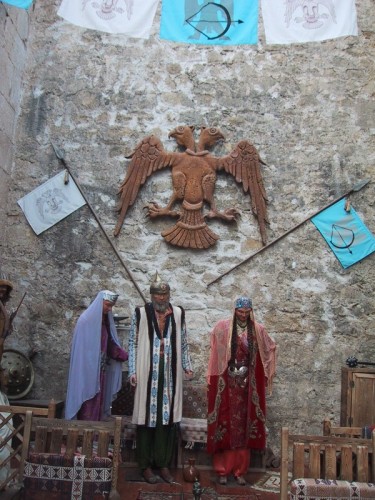
A diorama comprising mannequins dressed in traditional Seljuk costumes has been installed in the large iwan to the far end of the central corridor. The second ring is now equipped with dining tables to receive tourist groups, with kitchens installed to the rear. Some chairs and tables were installed in the stable, rendering it difficult to discern the architectural features. The decorative consoles inside the rooms were narrowed, encased and separated from the wall surface.
BIBLIOGRAPHIC REFERENCES
Acun, H. Anadolu Selçuklu Dönemi Kervansarayları. Ankara: Kültür Bakanlığı Publications, 2007, p. 454.
Aqsarayi. Kerimuddin Mahmud-i Aksarayi. Selçuki Devletleri Tarihi, 1943, p. 332.
Altun, Ara. An Outline of Turkish Architecture in the Middle Ages, 1990, p. 199.
Bayrak, pp. 85-86 (note the interesting pre-restoration photos).
Bektaş, Cengiz. Selçuklu kervansarayları, korunmaları ve kullanılmaları uzerine bir öneri = A proposal regarding the Seljuk caravanserais, their protection and use, 1999, pp. 74-76.
Bilici, Z. Kenan. Anadolu Selçuklu Çaği Mirası. Mimarı = Heritage of Anatolian Seljuk Era. Architecture. 3 vols. Ankara: Türkiye Cumhuriyeti Cumhurbaşkanlığı: Selçuklu Belediyesi, 2016, vol. 1, pp. 236-241.
Demir, Ataman. "Anadolu Selçuklu Hanları. Alara Han", İlgi, 51 (1987), p.18-23.
Duggan, T.M.P. "The Foundations Directorate wants dollars! Turkish heritage offered in exchange...." Turkish Daily News, June 27, 1998.
Eravşar, O. & Yavuz, A.T. Ortacağda Küzey Anadolu Yollari ve Yol Üstü Kurluşlari. 109K369 Tubitak Projesi Sonuç Raporu, ULAKBIM, 2010.
Eravşar, Osman. Yollarin Taniklari (Witnesses of the Way), 2017, pp. 523-534.
Erdmann, Kurt. Das Anatolische Karavansaray des 13. Jahrhunderts, 1961, pp. 184-187; vol. 3, p. 130.
Erten, F. Antalya Vilayet Tarihi. Istanbul, 1940, p. 79.
Ertuğ, Ahmet. The Seljuks: A Journey through Anatolian Architecture, 1991. p. 79.
Görür, Muhammet. “Anadolu Selçuklu Dönemi Kervansaraylari Kataloğu.” Acun, H. Anadolu Selçuklu Dönemi Kervansaraylari. Ankara: Kültür ve Turizm Bakanliği, 2007, p. 478.
Heberdey, R. & Wilhelm, A. Reisen in Kilikien, ausgefuhrt 1891 und 1892. Vienna, 1896, p. 135.
Karpuz, Haşim. & Kuş, A. & Dıvarcı, I. & Şimşek, F. Anadolu Selçuklu Eserleri, 2008, vol. 1, pp. 159-61.
Konyalı İ. H.. Alanya (Alaiyye). Istanbul, 1946.
Lanckoronski, K. Städte Pamphyliens und Pisidiens. Vienna, 1890-92, p. II, 187.
Lloyd, Seton, & D. Storm Rice. Alanya (Ala'iyya). London, British Institute of Archaeology at Ankara, 1958, pp. 45-48 (Lloyd was the first to correctly publish the plan; although he failed to include the mihrab in the room to the right of the entrance).
"Only Seljuk-era bazaar in Anatolia being unearthed". Hurriyet Daily News, September 15, 2018.
Özergin, M. Kemal. “Anadolu’da Selçuklu Kervansarayları”, Tarih Dergisi, XV/20, 1965, pp. 144
Rice, Tamara Talbot. The Seljuks in Asia Minor, 1961, p. 206.
Tschihatscheff, P.A. Reisen in Kleinasien und Armenien, 1867, p. 20.
Yavuz, Ayşil Tükel. "The Concepts that Shape Anatolian Seljuq Caravanserais". In Muqarnas XIV: An Annual on the Visual Culture of the Islamic World, Gülru Necipoglu (ed). Leiden: E.J. Brill, 1997, pp. 80-95. She uses the Alara han to illustrate her "Shelter" typology.
Yavuz, Ayşil Tükel. Alara Hanin Tanitilmasi ve Değerlendirilmesi. Belleten 33(132), 1969, p. 429-459.
Yavuz, Ayşil Tükel. Anadolu’da Eşodakli Selçuklu Hanlari. Mimarlik Fakultesi Dergisi, II/2. Ankara, 1976, pp. 187-204.
Yavuz, Ayşil Tükel. Restauro d’Alara Han. Roma Universitesi Mimarlik Fakultesi [doctoral thesis]. Rome, 1967.
Yavuz, A. T. “Kervansaraylar”, in Anadolu Selçukluları ve Beylikler Dönemi Uygarlığı (Mimarlık ve Sanat). Ankara: Kültür ve Turizm Bakanlığı Publications, 2006, pp. 425-443.
|
Eravşar, 2017. p. 531; photo I. Dıvarcı |
Karpuz, Anadolu Selçuklu Eserleri (2008) v.1, p. 159 |
|
"crying" lion lampholder |
handcrafted rug with the "logo" of the han |
|
Alara River |
Alara Hill and Castle Karpuz, Anadolu Selçuklu Eserleri (2008) v.1, p. 160 |
|
east outer wall |
fountain niche in hammam room |
|
gutter pipes on outer wall |
rear wall with gutter pipes and crenellations |
|
window slits, east wall |
diorama mannequins in Seljuk costumes
|
|
Seljuk Sanjak banner |
Mannequins and double-headed eagle, symbol of the Seljuks |
©2001-2026, Katharine Branning; All Rights Reserved. No part of this site may be reproduced in any form without written consent from the author.