The Seljuk Han of Anatolia
ERTOKUS GELENDOST HAN
A small, but finely-proportioned han, interesting for an unusual application of triangular buttresses, its narrow courtyard, an informative inscription plaque, its noteworthy statesman patron and a poetic setting on the shores of a deep blue lake.
|
Eravşar, 2017. p. 334; photo I. Dıvarcı |
|
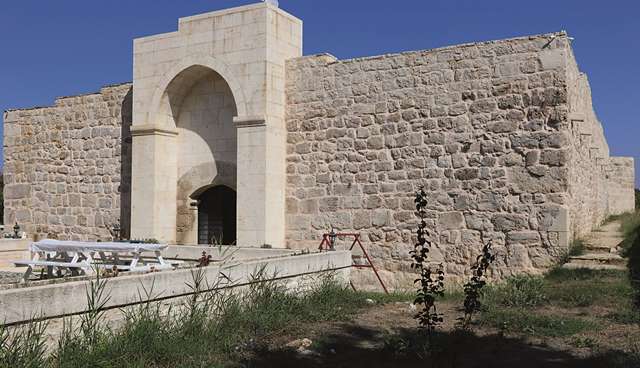
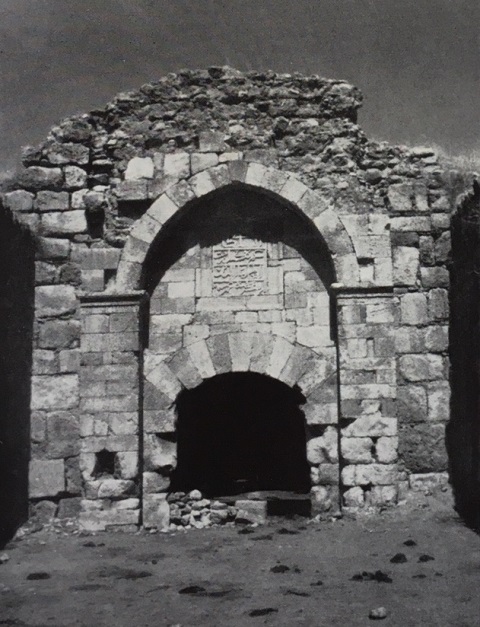
Main portal prior to restoration |
|
|
|
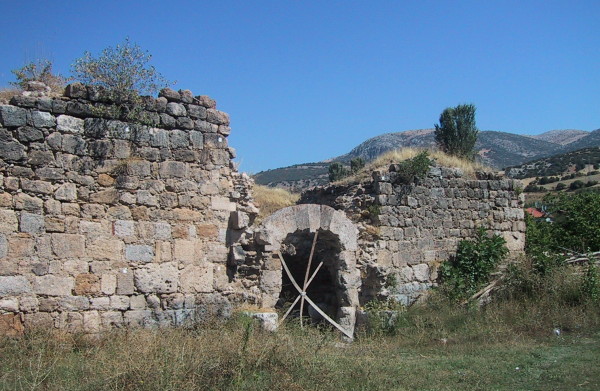
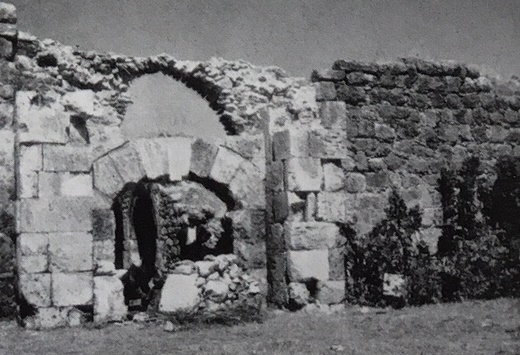
overview of the courtyard and covered section entry prior to restoration |
|
|
|
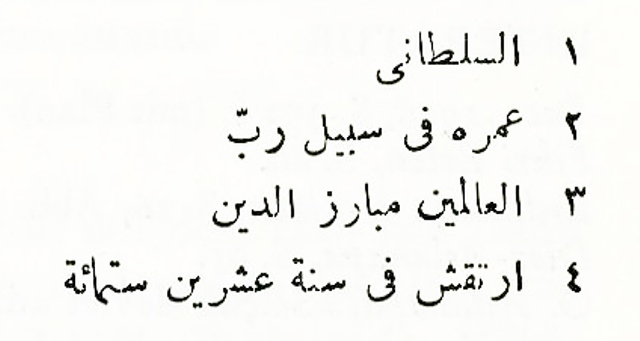
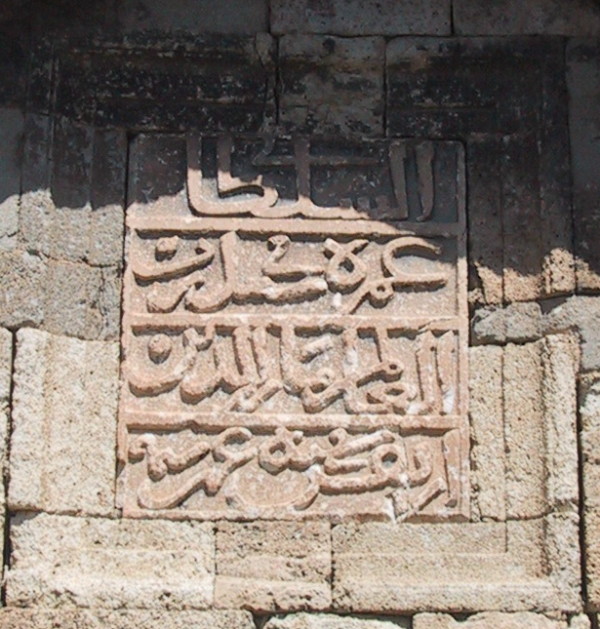
detail of inscription plaque (kitabesi) |
|
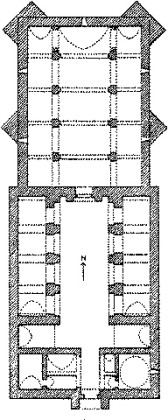
plan drawn by Erdmann |
|
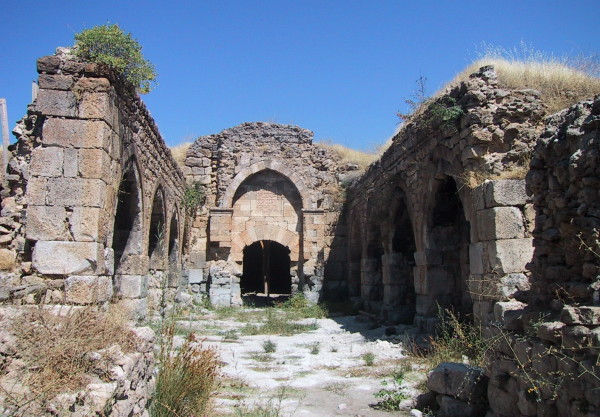
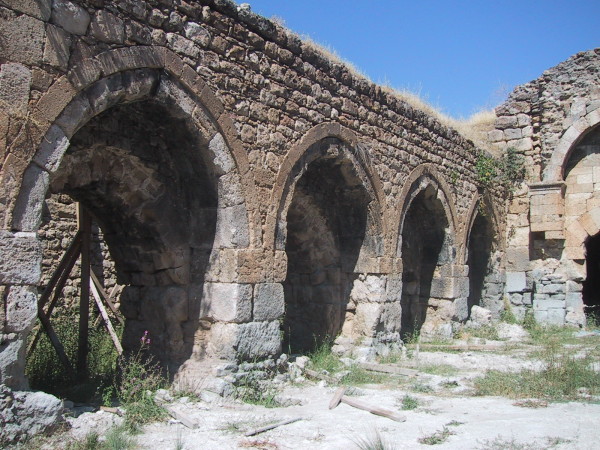
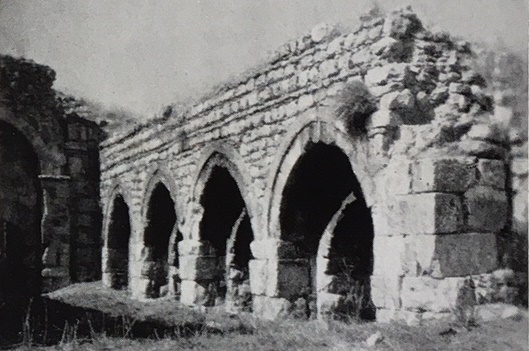
courtyard, western portico, prior to restoration |
|
Eravşar, 2017. p. 239; photo I. Dıvarcı |
|
Eravşar, 2017. p. 240; photo I. Dıvarcı |
|
photograph by Ibrahim Divarci, used by permission |
DISTRICT
32 ISPARTA
LOCATION
37.993002, 30.970983
The Ertokuş Han is located on the Eğridir-Gelendost-Akşehir
Road, on the eastern shore of Lake Eğridir at the northern
end. It is in the village of Yeşilköy,
north of the village of Mahmatlar, approximately 30 miles northeast of Eğridir,
100 ms from the lakeshore, between the lake and the road (Right after you enter
the village of Yeşilköy, you will
see a roadstop tea house to the left, aptly
named "Han Onü Çay Evi". At this
point, looking towards the lake, you should be able to discern the top of the
han peeking above the apple trees. Right after the Çay Evi, you will take the
first turnoff to the left. This is a small dirt road, which is a private
access road leading to the houses
below. You will pass a cluster of farm houses, and the road will end at a house
near the lake, with the han located right next to it.)
It is on the old Antalya-Afyon trade route. The next han in the direction of Isparta is the Eğirdir Han, which is in the town of Eğirdir.
NAMES
Gelendost Han, Selçuk Han, Kudret Han
Many local and foreigner travelers, such as Arundell, Hamilton and Pace, visited the han, but none called it by a specific name.
DATE
1223-1224
REIGN OF
Alaeddin Keykubad I
INSCRIPTION
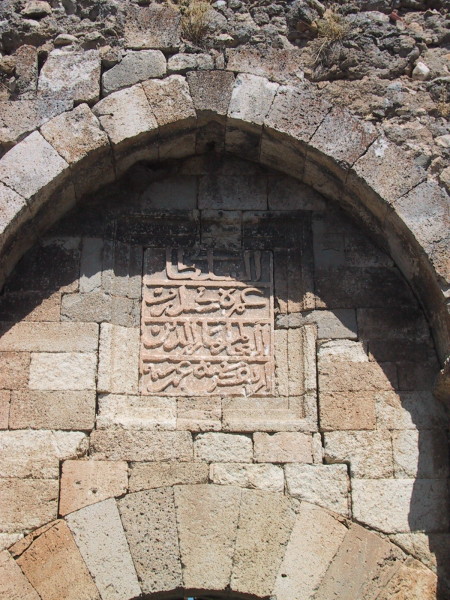
The han is dated by an intact inscription in marble over the door of the covered section, in 4 lines of nakshi script. The inscription plaque is recessed about 80 cm under a slightly broken arch. The simple inscription states that the han was built for the Sultan in the year 620 (1223) by the Emir Mübarizeddin Ertokuş.
The inscription reads as follows:
This building, which belongs to Sultan, was built by Mubarizeddin Ertokuş Ömer for the sake of Allah in Hijri 620 (1223-1224).
PATRON
The patron of this han is one of the most loyal of all the Seljuk
statesmen, with over 40 years of service to the crown. According to the inscription, this han
was commissioned in Hijri 600 (1223) by the statesman amir
al-savahil Mubarizeddin Ertokuş,
Atabeg of Isparta, a well-known dignitary at the court of Alaeddin Keykubad I.
He appears to have been a slave manumitted by Izzeddin Keykavus I, and then then in
1207 became the commander of the armies of the Sultan Giyaseddin Keyhüsrev on the southern territories of the Seljuk
Empire for more than 20 years. He remained the military governor of Antalya from
its conquest in 1207 until the death of the Sultan in 1211. He was instrumental in the campaign of Alaeddin
Keykubad I to capture Alanya in 1221, and was one of the Sultan's most important
and trusted emirs. Later, he became the head military commander in Erzincan
after the annexation of the city in 1228, and served as the tutor to Giyaseddin Keyhüsrev II,
the eldest son of Alaeddin Keykubad. It is not known when he died.
Ertokuş was a Seljuk atabeg who had charitable foundations and sponsored other structures in addition to this han. He also built a medrese and a tomb in Atabey, a nearby village northwest of Eğirdir, in 1223. He may also have built the Pinarbaşı Han (no longer standing). He built a medrese and a tomb in Eğirdir and a bridge between Sivas and Tokat, now demolished. The date of 1223 corresponds with the other building activities of Ertokuş in and around Eğirdir. His foundation has left us one of the three vakif documents pertaining to a han. His charter mentions that Mubarizeddin Ertokuş built a medrese, a mosque and a han, but it does not provide any details about the operations of the han.
BUILDING TYPE
Covered section with an open courtyard (COC)
Covered section is smaller than the courtyard
Covered section with 3 naves perpendicular to the rear wall
5 lines of support cross vaults parallel to the rear wall of the covered section
DESCRIPTION
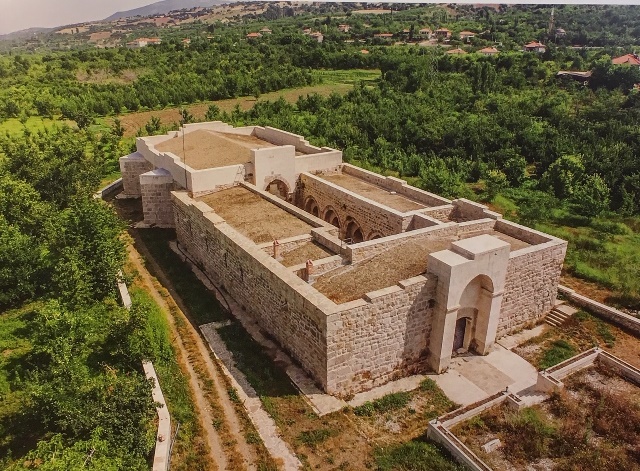
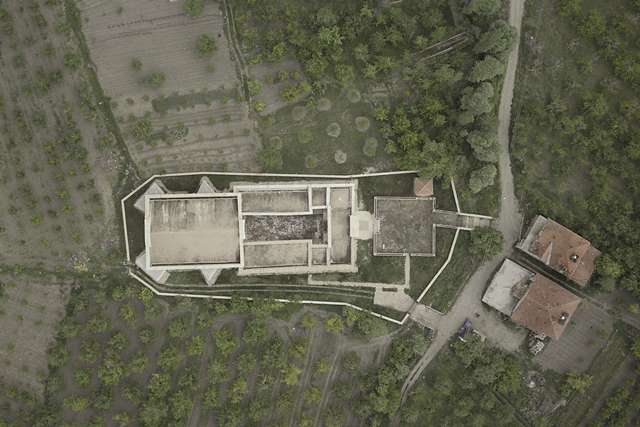
The han lies parallel to the road, with the door facing south to Eğridir. The han has a north-south axis and a combined plan of a covered section for lodging and an open courtyard for service facilities. Both sections are approximately the same size, but the covered section is wider than the courtyard. The han shares the same plan as the Durak, Çekereksu, Dokuzun Derbent, Altinapa and Kuruçeşme Hans.
Courtyard:
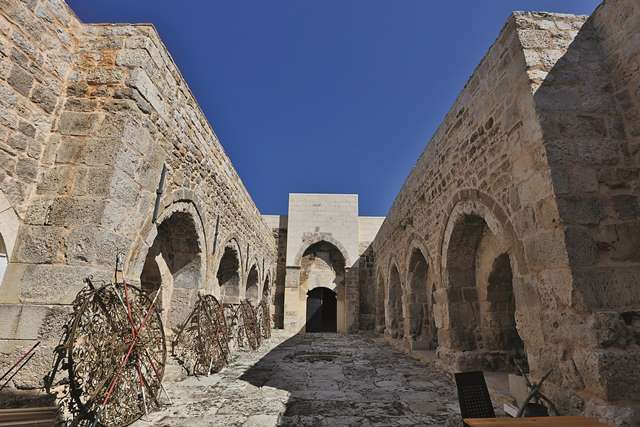
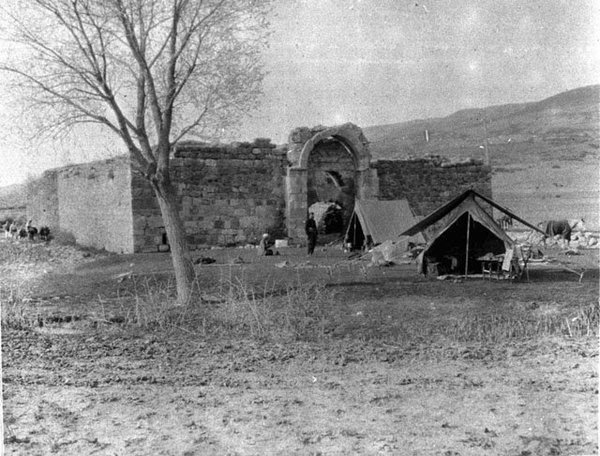
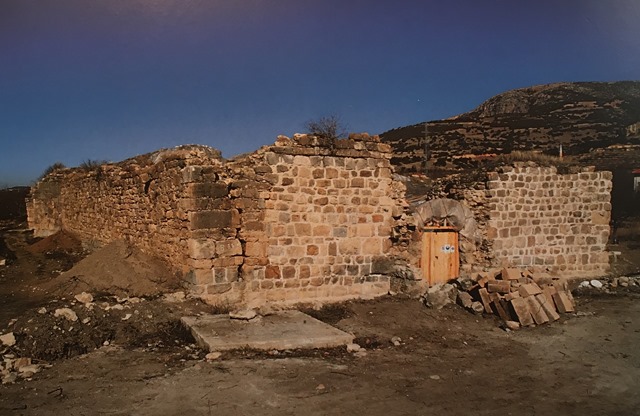
The deteriorated crown door of the courtyard section was rebuilt during the restoration. Only the section with the depressed arch was present before the restoration. Gertrude Bell, who visited the region at the beginning of the 20th century, photographed the han. In her photographs, the crown door of the courtyard appeared solid and had the same features as the crown door of the covered section.
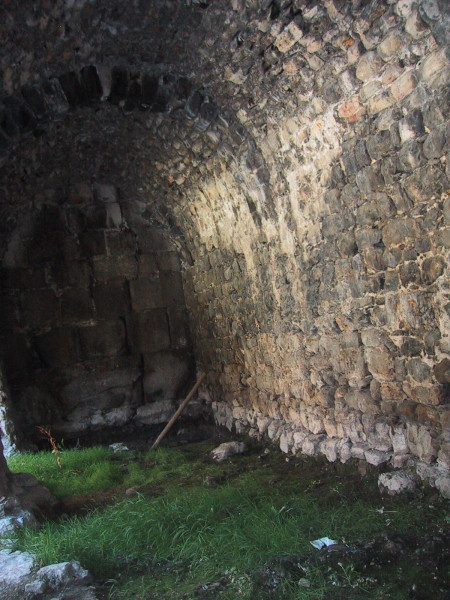
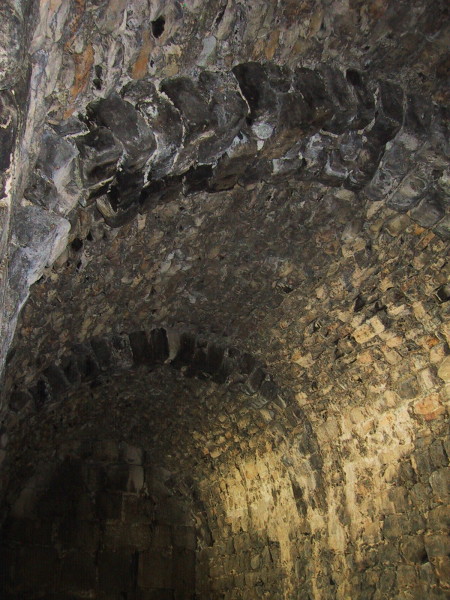
The narrow courtyard is formed by six arched arcades carried on three piers on each side. The arcades are covered by pointed vaults heading towards the courtyard in the east and west directions. The two arcades of 4 vaults on either side of the courtyard are covered with barrel vaults.
There is a group of 3 rooms on each side of the door to the courtyard door, immediately past the opening, which could have served as the bath or kitchen. The first sections of these rooms have two storeys, reached via the iwans. Both sections are entered through a door with a flat arch. Past the door, two small rooms of the same size are located in the north-south direction and are covered with barrel vaults. These two open iwans on each side of the courtyard in front of the arcades of vaults could have served as guard rooms or for general administrative functions.
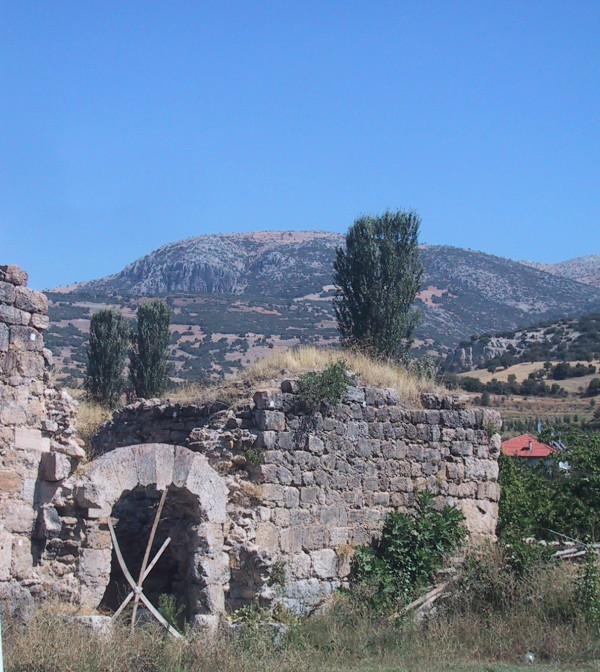
The easternmost room is covered by a dome. It is believed that this domed section to the east of the entrance of the courtyard could have served as the mosque, but no trace of a mihrab can be found. The dome is carried by squinches. Erdmann mentioned the gatch work in this domed room, but this plaster ornamental decoration no longer exists. He also said that this place was known by the locals as the baths.
During the excavation project carried out in 2003 in preparation for the renovation, a hexagonal pool was discovered in the courtyard, 2.10 m from the east and west arcades. The pool had a square basin lines with terracotta tiles. On the northwest corner is a monolithic stone piece which is believed to have been the water conduit for the pool.
Covered section:
The crown door of the covered section has a pointed, arched opening which is recessed approximately 40 cm. The arch is composed of stones of two different colors. It is much simpler in design than the classic Seljuk portal.
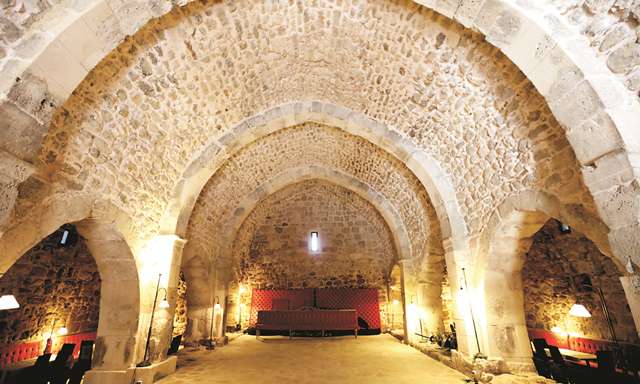
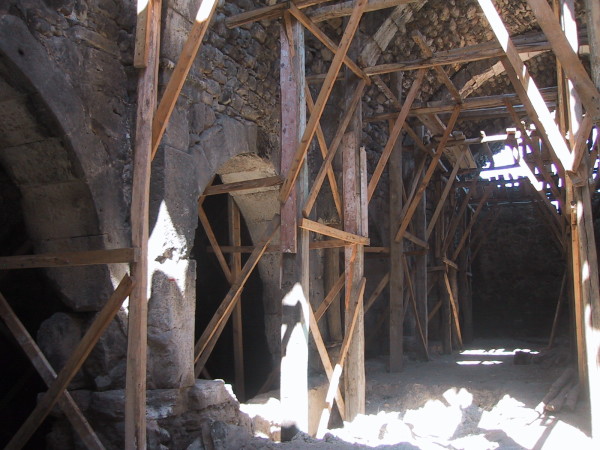
The covered section is slightly smaller than the courtyard in width, and comprises three aisles, with the center aisle being twice as wide as the two side aisles (6.5 m). There are two support lines. Five pointed arches on four piers in each support line continue towards the rear wall in the north-south direction.
The middle nave is higher and wider than the side naves. The piers are also connected to each other by horizontal connecting arches in the north-south direction. A platform under the middle nave of the han was uncovered during the excavations completed in recent years. Erdmann said that some were Byzantine period columns in the covered section, but all were replaced during the restoration.
There are 2 slit windows in the upper section of the walls at the second and fourth bays on each side of the covered section, and one in the rear wall.
EXTERIOR
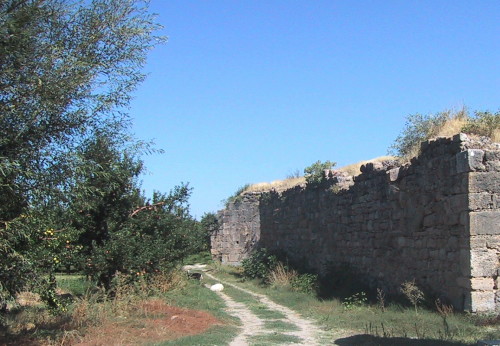
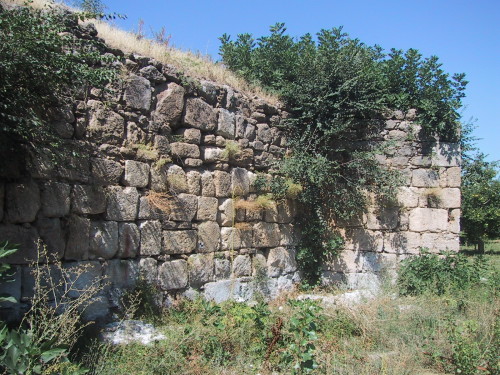
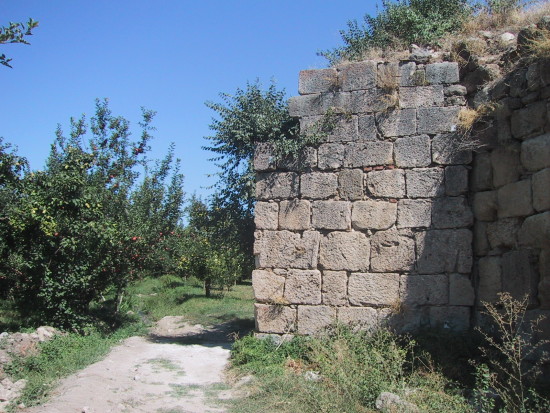
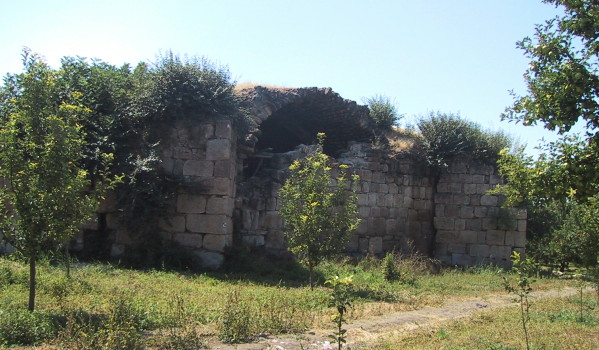
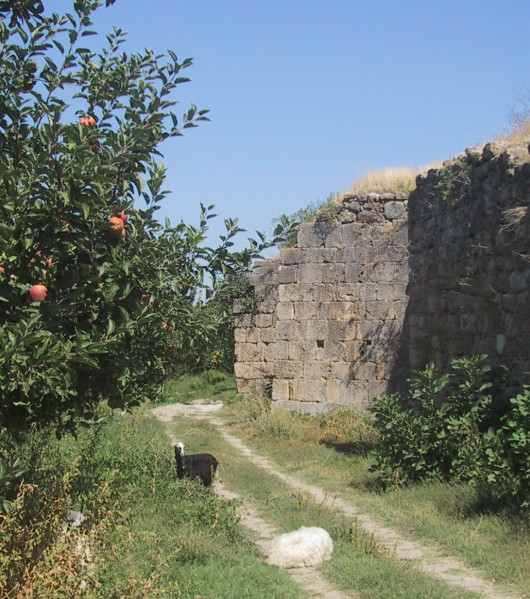
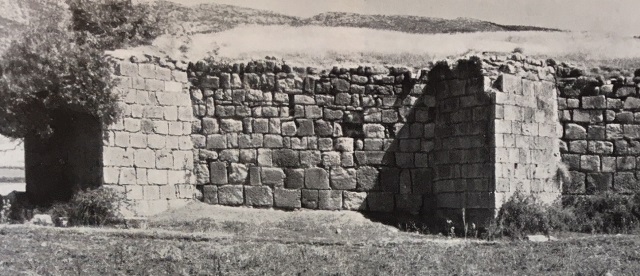
The east and west walls of the covered section are reinforced by triangular buttresses and rectangular buttresses are placed diagonally in the north corners. This is the only known example of a han with this application of diagonal buttresses.
BUILDING MATERIALS
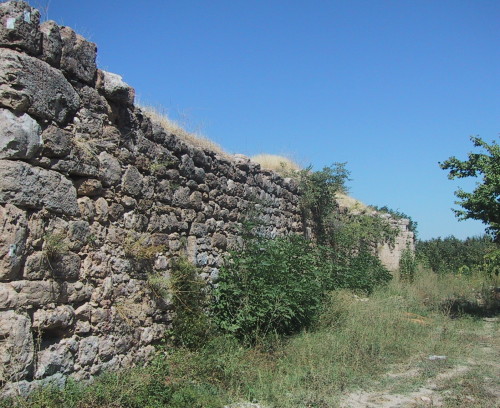
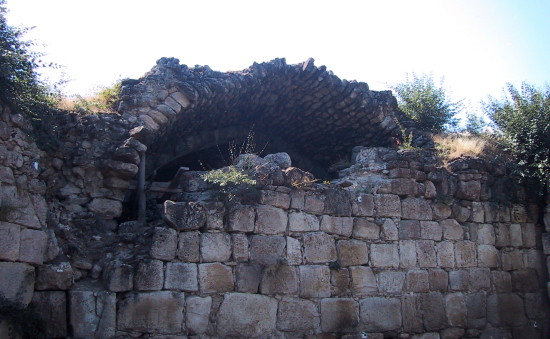
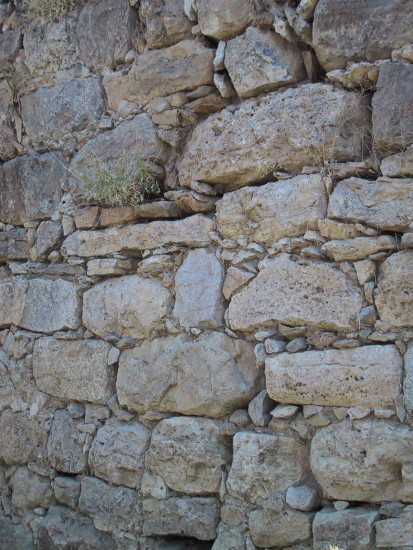
The roof of the covered section is made of pitch-faced stone. The exterior walls are made of large square cut stones. The han was built using the rubble wall technique, which consists of filling a mixture of mortar and rubble between walls built of two thick stones. The arches in the side naves of the covered section are made of brick.
DECORATION
This is a very plain
building, and apart from the impressive inscription plaque, there is no
decoration on the interior or exterior walls.
DIMENSIONS
Total area is 1,030 m2
Area of covered section: 340m2 (14.5 x 21 m)
Area of courtyard: 495m2 (18 x 26m)
STATE OF CONSERVATION, CURRENT USE
For many years, the portal and the courtyard walls were in poor
condition. The han had deteriorated considerably since the time it was
photographed by Erdmann in the 1950's. The intact portal can be viewed in the
photographs taken by Gertrude Bell in 1907, when she camped at the han during
her horseback trip across Turkey. An extensive renovation of the han was started
in 2007 and has now been completed.
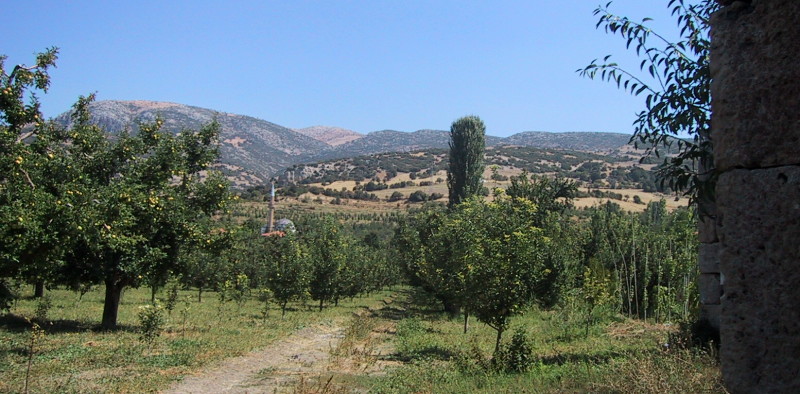
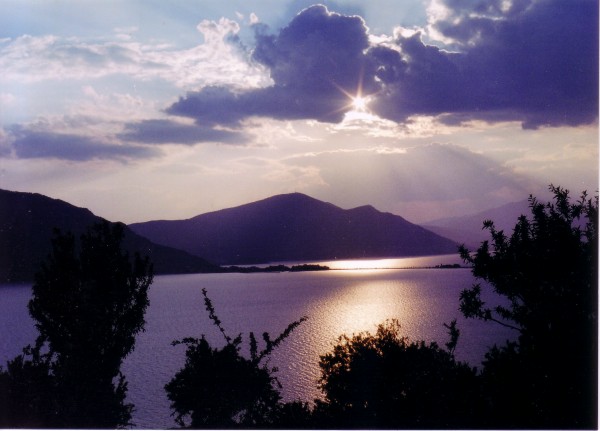
A visit to this han, lost among the apple orchards in a poetic setting at a spot where the mountains meet the sweet blue waters of the poplar-lined Lake Eğirdir, is memorable. A few days spent relaxing in the tranquil town of Eğirdir is quite restorative to the soul.
BIBLIOGRAPHIC REFERENCES
Arundell, F. V. J. Discoveries in Asia Minor, including a Description of the Ruins of Several Ancient Cities. London: 1834, v. I, p. 327).
Aslanapa, Oktay. “Selçuk Devlet Adamı Mübarüziddin Ertokuş Tarafından Yaptırılan Âbideler.” İslam Tetkikleri Dergisi, II/1, 1957, pp. 97-111.
Aslanapa, Oktay, Anadolu'da İlk Türk Mimarisi, Başlangıcı ve Gelişmesi. Ankara: Atatürk Kültür Merkezi Yayını, 1991.
Bektaş, C. Selçuklu Kervansaraylari, Korumalari ve Kullanilmalari Üzerine Bir Öneri = A proposal regarding the Seljuk caravanserais, their protection and use, Istanbul, 1999, pp. 58-59.
Bell, Gertrude. The Gertrude Bell Archives. Internet web document. www.gerty.ncl.ac.uk/, folder F, photos F250, 251, 253, 254.
Bilici, Z. Kenan. Anadolu Selçuklu Çaği Mirası. Mimarı = Heritage of Anatolian Seljuk Era. Architecture. 3 vols. Ankara: Türkiye Cumhuriyeti Cumhurbaşkanlığı: Selçuklu Belediyesi, 2016, vol. 2, pp. 84-85.
Demir, Ataman."Anadolu Selçuklu Hanları. Ertokuş Han", İlgi, 60 (1990), pp. 22-25.
Demirci, Doğan. “Ertokuş Han”. In Acun, H. Anadolu Selçuklu Dönemi Kervansarayları. Ankara: Kültür Bakanlığı Publications, 2007, pp. 122-139 (includes bibliography).
Doğan, N.S. “Selçuklu Döneminde Siyasi ve Bani Kimliği ile Mübarizeddin Ertokuş.” Edebiyat Fakültesi Dergisi 27(1), pp. 231-251. (Doğan read the date of the inscription as H.600 (1203 AC) which does not correspond with the reign of Alaeddin Keykubad).
Eravşar, Osman. Yollarin Taniklari (Witnesses of the Way), 2017, pp. 234-241.
Erdmann, Kurt. Das Anatolische Karavansaray des 13. Jahrhunderts, 1961, pp. 51-54, no. 11.
Erten, F. Antalya Vilayet Tarihi. Istanbul, 1940.
Görür, Muhammet. “Anadolu Selçuklu Dönemi Kervansaraylari Kataloğu.” Acun, H. Anadolu Selçuklu Dönemi Kervansaraylari. Ankara: Kültür ve Turizm Bakanliği, 2007, p. 496.
Hamilton, W. Researches in Asia Minor, 1842, v. I, p. 479.
Hillenbrand, R. Islamic Architecture: Form, function and meaning, 1994, fig. 6.49, p. 552.
Karpuz, Haşim. & Kuş, A. & Dıvarcı, I. & Şimşek, F. Anadolu Selçuklu Eserleri, 2008, vol. 1, p. 376.
Kiepert, R. Karte von Kleinasien, in 24 Blatt bearbeitet, 1902-1916.
Özbek, Ömer. "Eğirdir Mübarizüddin Ertokuş Kervansarayı", Vakıf Dergisi, XI (1976), pp. 293-311.
Özergin, M. Kemal. “Anadolu’da Selçuklu Kervansarayları”, Tarih Dergisi, XV/20, 1965, p. 149, n. 34.
Pace, B. Richerche nella regione di Conia, Adalia e Scalanova. Annuario della R. Scuola Archeologica di Atene e delle Missioni Italiane in Oriente, 1926, pp 392-93.
Rice, Tamara Talbot. The Seljuks in Asia Minor, 1961, p. 206.
Turan, O. Muhabarizeddin Ertokuş ve Vakfiyesi [Muhabarizeddin Ertokuş and His Foundation Charter] in Belleten 1947, vol. 11, pp. 415-429.
|
Eravşar, 2017. p. 236; photo I. Dıvarcı |
|
|
Photograph (F253) of the han taken by Gertrude Bell in April, 1907
|
|
|
outer west wall with triangular side towers
|
Karpuz, Anadolu Selçuklu Eserleri (2008) v.1, p. 376
|
|
outer wall, east |
outer wall, north, with side tower |
|
outer wall, north, partially collapsed and showing barrel vault of main aisle of covered section |
outer wall, west, and triangular side tower |
|
outer wall, north, partially collapsed and showing barrel vault of main aisle of covered section |
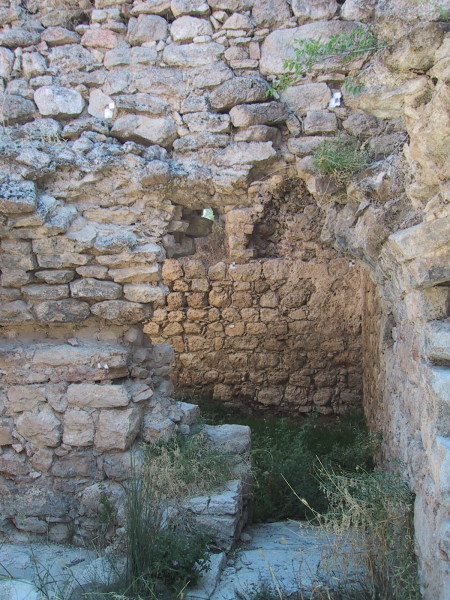
east side cell at entry
|
|
barrel vault in eastern aisle of the covered section |
detail of barrel vault in eastern aisle of the covered section
|
|
masonry detail, outer wall west |
covered section, main aisle |
|
outer wall, west, and triangular side tower
|
main portal before restoration
|
|
Photo by Erdmann (#59) |
Photo by Erdmann (#60) |
|
Photo by Erdmann (#61) |
Photo by Erdmann (#62) |
|
setting of the Ertokuş Han |
|
|
Sunset over Lake Eğirdir |
|
©2001-2026, Katharine Branning; All Rights Reserved.