The Seljuk Han of Anatolia
Introduction and definition
WHAT IS A HAN ?
The architecture of the Seljuks of Anatolia (1077-1307) is seen at its most spectacular in an impressive group of buildings called caravansarais, or hans, many of which still stand today. These buildings and the organization of their services are a testament to the energy and creativity of this short but glorious period of Islamic history. As states the German archaeologist Kurt Bittle in 1961:"Whoever stood in the wide landscape himself, in front of one of these great hans, will never forget the deep resonance they emanate and will have felt, too, how they are an expression of that High Culture which distinguishes the Sultanate of Konya in the High Middle Ages."
The word "caravansarai" is also rendered as caravanserai, caravansary, caravansaray, or caravansara. The word is based on a combination of the Persian words “karvan” (caravan, meaning a group of people engaged in long-distance travel) with “sara” (palace with enclosed courts) and the nominative suffix “yi”. A caravansarai is also known as khan in Persian, han or kervansaray in Turkish, and funduq in Arabic.
A caravansarai is a building to house an overnight stop-over of a caravan, which is a body of merchants who travel together for greater protection. These buildings are generally known in Turkish as "hans" or a "kervansarays". More than just overnight inns along the road, these structures were often palatial and offered many services to their guests. In addition to their trade purposes, t can also be considered that these buildings served as depots for goods, treasuries for collected taxes, postal relay stops, military lodging, depots for military equipment and military guard posts.
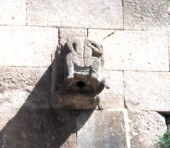
The typical Seljuk han is a monumental stone building with a large, highly-decorated main portal which provided access to an open courtyard and a vaulted covered section to the rear. The outside walls are plain but may have side towers and supporting buttresses of cylindrical, half-octagonal or half-hexagonal shape. In the larger hans, there are gutter spouts in the shape of stylized animals heads. The main portal is often elaborately decorated in carved stone with bands of geometric patterned elements, rows of Qur'anic inscriptions and stalactite vaulting known as muqarnas. Once inside the main door, the visitor enters a large courtyard, surrounded by service rooms (dining hall, treasury, baths and latrines, repair shops and stores). The vaulted covered section to the rear could also have a richly-decorated entry door. This rear covered section was lit by a raised cupola in the middle and small slit windows in the side walls.
Hans constituted the second largest group of Seljuk-era buildings after mosques. It is estimated from texts and references that there were over 250 built in Seljuk times. Today, approximately only a hundred or so remain in various states of repair. Some are intact, some restored, and many are in a ruined condition. The Turks began building hans upon their arrival in Anatolia. The earliest dated han appears to have been built in 1210 by Sultan Giyaseddin Keyhüsrev I, but the majority were built during the glory days of the Seljuk Empire from 1220-1250.
Six of the hans are known as “Sultan Hans”, as they were commissioned directly by the reigning sultan. These Sultan Hans include the Evdir, Sultan Han Aksaray, Sultan Han Kayseri, Incir, Şarafsa and Alara hans. Other hans were built by the emirs or statesmen of the Empire, royal family members, or private patrons.
The Seljuk sultans of Rum, established in their capital at Konya, realized the importance of commerce to the prosperity of their empire. They set out to encourage incoming revenue by increasing the flow of goods throughout their lands. The first step undertaken was to repair the existing trade routes which had served merchants for generations. They had fallen into disrepair during years of constant warfare. These roads were repaired, and existing bridges were solidified and new ones built. The Seljuks then undertook the construction of a network of merchant way-stations along these roads. This network was largely responsible for the expansion of domestic and international trade. Hans connected trading centers inside and outside the Empire, such as Tabriz, Baghdad, Aleppo, Alanya, Antalya, Izmir, Istanbul, Trabzon, Erzurum and Kayseri. These hans were built along trade routes which served the major cities of the empire. One main route led north from Antalya on the Mediterranean coast through Konya and Aksaray and on eastwards to Erzurum, and another led from the Black Sea coast to Tokat, Sivas, Amasya, and Malatya. Hans were constructed at a distance of every 18 to 25 miles, calculated on the distance a camel could cover in 9-10 hours, although this is not a fixed rule. Caravans were led by hard-driving entrepreneurs who often pushed their camels for 15-19 hours at a stretch. Some of the camels carried more than 400 pounds, and could go for 10 days without a drink of water. In some cases, hans were spaced close together (for example, the 4 hans on the short stretch of road between Konya and Beyşehir) or at great distances apart (in the east).
Hans did not serve just the needs of commercial caravans but fulfilled other roles. They probably had military uses, as did their predecessors, the ribats of Transoxania. They served as well as royal guesthouses for visiting sultans and dignitaries, as prisons, dervish lodges, government outposts for the Sultan during military campaigns, temporary residences for the Sultan while traveling to the various cities of his empire, and probably as post offices. They were the backbone of the communication network of the Empire. Information shared in the hans spread on to the entire Empire. State officers, known as "kasid" or "kussad" circulated as messengers throughout the Seljuk territories. The Karatay Han was used by Seljuk emirs for hosting ceremonies, and was also used by the Mamluk sultan Baibars when he came to Anatolia in 1277.Yet it is in their role as commercial structures that the hans will be remembered. In addition to ensuring support for trade, hans proposed a social services structure. The building of hans and the social structure provided by them represent one of the most liberal institutions created by the Seljuks. Every traveler, whatever his nationality, religion or social status, was entitled to three days lodging with food, medical care and other services, all at the expense of the State. Complete care for animals was provided as well, with the larger hans able to house up to 400 beasts of burden (donkeys, camels, and horses). To provide these services, each han employed physicians, imams (religious official), inn keepers, blacksmiths money changers, tailors, cobblers, superintendents of provisions, veterinarians, messengers, and cooks.
Although most hans were built with operating endowments (usually by the Sultan, his family or his principle viziers) to ensure their upkeep and service needs, they also generated the revenue for the State coffers.
The basic functions of hans were thus to provide safety, shelter and services to tradesmen:
Safety was ensured by the thick stone walls, a single entrance with wooden bar to secure it, buttresses and crenellations, roof watch platforms and small slit windows.
Shelter: All hans included stables for bedding and feeding of animals, places for loading and unloading of goods, and accommodations for travelers. Most hans included two storeys. The lower section at the ground level was reserved for animals, and an upper area, usually comprised of a raised flat platform approximately 3 feet high, was reserved for humans and goods. These raised "loading dock" platforms made the backbreaking work of loading and unloading of goods much easier. Some of these docks include a row of basins underneath the arches, possibly for fodder and water for the animals. People spread their bedding along these raised platforms, as they offered some elevation from the dirt and animals. A few of these platforms show remnants of the traditional tandir clay ovens used for heating, cooking and baking bread.
Service areas were generally located on the sides of the courtyard. These comprised open galleries and/or rooms (open or closed). The service facilities included spaces for administrative offices, food supplies, bathing and latrines, loading areas, storage and religious needs. The most common service areas were single or double galleries with vaults parallel or perpendicular to the exterior wall. These single or double galleries accommodated people, goods, and animals in warm weather. The raised "loading dock" platform was nearest to the arched openings, and the rear area comprised the stable section. In many cases, the courtyards included enclosed spaces lining the sides of the courtyard, generally on one side only. There were often larger, interconnected rooms near the entrance which were used for storage and administration. The smaller courtyard rooms were used for accommodations and often had a slit window in the back wall or a window over the door. There is no generic rule determining the layout and the number of rooms or galleries, with each han presenting its own particular take to the organization of the services and their subsequent arrangement. The courtyards also included iwans, which are large open spaces enclosed on three sides. They were used for daytime use of travelers and sometimes for sleeping in warm weather. Generally set 1-2 feet above ground level, they offer a separation from the bustle and dustiness of the courtyard level where the animals circulated.
Expenses for construction and maintenance were borne by the Sultan, or by other court members or private wealthy individuals who established foundations for their operating expenses. The deeds of trust of these foundations spelled out the guidelines of operations for each han. In addition, the State provided an insurance policy to compensate merchants who were attacked or robbed along the Seljuk roads. Foreign merchants who came to Anatolia enjoyed extensive rights and reductions on customs duties.
There was a frenzy of han building in Seljuk Anatolia during the 13th century, and comprised a homogenous type. The majority of these establishments were built during the period of great commercial expansion brought about by Giyaseddin Keyhüsrev I, Izzeddin Keykavus I and Alaeddin Keykubad, in the years of 1204-1246. They belong to what is known as the "Classical period" of Seljuk architecture. According to contemporary sources (the Danishmendname and Ibn Bibi's Seljuqname), the Sultans themselves stayed in hans, or used them for army postings. Sultan Hans were used by Izzeddin Keykavus and Rükneddin Kiliç Arslan as fortresses, where they gathered their troops of some 10,000 men. Baybars I of Egypt stayed at the Karatay Han during his siege of Kayseri in 1276. Alaeddin Keykubad reportedly stopped at his sultan han on his trips to and from the capital of Konya to Kayseri.The great Gothic cathedrals of Amiens and Rheims in France were being completed at the same time as these Seljuk hans were built. Although more modest in program and construction techniques than these cathedrals, the Seljuk hans deserve to stand at their side in the historical timeline of great architectural endeavors.
DESCRIPTION
Because so many Anatolian hans stand today, it is possible to study them and formulate generalizations about their plans, decoration, patronage and the road networks of the time. Please consult the section “Architecture of the Hans” for a more detailed discussion.
Although no two hans have the same exact plan, they all display the following characteristics:
They are all of rectangular or square shape, and are built following one of 4 basic building plans. They range in size from 500m2 to 4800 m2.
They were built of finely-hewn blocks of honey-colored local limestone (as opposed to the brick architecture of Iran or Byzantium), and their walls were thick and high to ensure safely from raids.
There was a single, projecting monumental entrance gate, which insured control of comings and goings as well as providing security and defense. There was a vaulted vestibule inside the entrance, which contained rooms for the guards and other administrative services.
Decoration was concentrated on these entrance gates, which display some of the finest examples of Seljuk stone carving. The portal doors were made of iron to repel intruders. The decorative focal point of the han, they were enhanced with bands of geometric patterns, Qur'anic verses in stylized Arabic calligraphic script, and stalactite vaulting (muquarnas).
The massive solid outer walls were strengthened with rectangular, round or square towers at the corners and at intervals along the side walls, lending a fortress-like appearance. The walls are made of well-joined smooth stone, with no decoration, except for the corner towers and buttresses, which had geometric shapes (half-cylinder, or half octagon, or half-hexagon). The drain spouts for rainwater were often in the shape of animal or human heads.
The entry portal led to a small entry vestibule, flanked by niches for guards and containing a room for the han's manager. This small hall led to a vast courtyard, surrounded by cells on one or two storeys. The caravans loaded and unloaded in these open courts. The courtyard also served for stabling or shoeing the animals. Iron rings were imbedded in the masonry for tethering. The courtyard sometimes had a raised central platform for storing goods above the ground and for facilitating loading and unloading. Animal attendants and grooms also may have slept here.
The ground floor cells around the courtyard served many purposes: storage rooms, baths, lavatories, refectories, treasuries, repair shops, accounting and exchange offices, and granaries. The second storey cells comprised the sleeping quarters. They were heated by braziers and illuminated by candles and lamps.
At the far end of the courtyard, a second massive decorated portal led into a large covered section, with columns and piers arranged in rows to support transversal aisles with barrel-vaulted ceilings. The larger central aisle could contain a central cupola pierced with windows. These covered sections were generally poorly lit by slit windows set at a great height. It was in these covered sections that the goods were stored. Animals and their drivers were probably stabled here in the winter months. Built-in stone water troughs were also provided. The length of the central main aisle in relation to its height was generally 3:1, and the relation of the length to width was 1:1.6.
Interior cells for sleeping were generally equipped with built-in fireplaces, cupboards and raised sleeping platforms.
Most hans provided an area for prayer. If the han contained a separate mosque, it was either in the form of a cube in the middle of the courtyard (called a "Kiosk mescit"; seen in 4 hans) or was placed to the right of the entry vestibule or immediately above it, reached by an internal staircase. Many hans had simple stairways which led up from one side of the courtyard to the flat roof which was used for communal prayer.
A water source was generally located nearby (river, stream or lake), and fountains were sometimes provided in the courtyard. Many hans had their own interior water systems, including drainage and sewers. These wet systems serviced the latrines, baths and fountains. Not every han provided a separate bath (hammam).
Lighting: the covered areas of the hans have slit windows in the exterior walls, and several had additional openings to the exterior than the main door. The larger hans had a central oculi opening in the ceiling, which served for both lighting and ventilation purposes. The interiors of the covered sections were probably lit as well by lanterns, as can be seen by the system of lion-head oil lamp holders in the Alara Han.
Ventilation: Hans often include a row of small rectangular holes at the level of the arch springing which appeared to have served for ventilation more than light, as they are quite small.