The Seljuk Han of Anatolia
Seljuk Glass
Although glass is as old as civilization itself, few traces of it have been discovered in archeological sites in Turkey. Glass-making does not appear to have been an important industry in Anatolia, as compared to ancient Egypt, Iraq and Iran. Remains of glass ovens, dating from the 6th c. BC, have been found at Sardis, the famous capital city of the Lydians, but no other oven remains have been discovered.
Intact glass objects from antiquity are rare, due to the fragile nature of the material. Compared to the contemporary production in Iran and Syria, only a few rare glass objects from Seljuk-era Turkey have been identified. However, the underwater archaeology expeditions of the Serce Limani shipwreck off the Turkish coast at Bodrum, dated to the 11th century, have shown that glass was an important maritime trading commodity in the area. In all probability, glass was imported by ship to Turkish ports along the Mediterranean from Syria and Iraq, the two major centers of glass production in the Islamic period. Raqqa and Aleppo were important centers for glass production and the Seljuks maintained active trading relationships with the Abassids. Some small-scale glass production must have existed in some form in Anatolia during the Seljuk period, much as it did in the other parts of the Near East at that time. Lamps and other daily implements were normally fabricated out of clay, and glass luxury items, such as beakers and platters, must have been a rare commodity cherished by those able to afford them.
The excavations of the site of the Kubadabad Palace of Sultan Alaeddin Keykubad I on Lake Beyşehir have revealed fragments of glass. Fragments from the stucco window grilles and pieces of molded stucco from elaborate cupboards found on the site most probably held glass. Pieces of plain and stained window glass have been found in the small hamam of the Palace, in turquoise blue, cobalt blue, manganese purple and green. Professor Rüchan Arik affirms that bracelets, beads, bottles, lamps (with and without handles) and drinking beakers, made in red, yellow and green glass, have been found on the site. She has also found the traces of a glass furnace on the site with glass cullet on its walls, as well as remnants of the raw materials used in glass production (cullet and glass rods) as well as several glassmaking tools (scissors and pincers). These findings distinguish this furnace from a ceramics kiln. Simple wares such as lamps and goblets for everyday use were probably manufactured on the site, and the more sophisticated products were probably imported from the accomplished Syrian-Iraqi studios. Research in progress by Zekiye Uysal will shed more light upon this subject.
Several buildings in Konya, including the Hoja Hasan Mosque, also provide evidence that colored glass was set in stucco panels in a stained-glass fashion. In addition, transparent yellow, greenish-blue, and dark red glass wine goblets, glasses, and cups similar to those found at Kubadabad have been discovered at the Palace of the Alanya Iç Kale and at Samosata.
Ahmed al-Aflaki writes in his Mahaqib al-Arifin that Mevlana referred to a person in his entourage as a "glassmaker" and this shows that the profession existed in Turkey in the 13th century. However, it perhaps is not certain if Mevlana was referring to a glass-seller or a glass-maker, but nonetheless, it shows that glass was a part of daily life at the time.
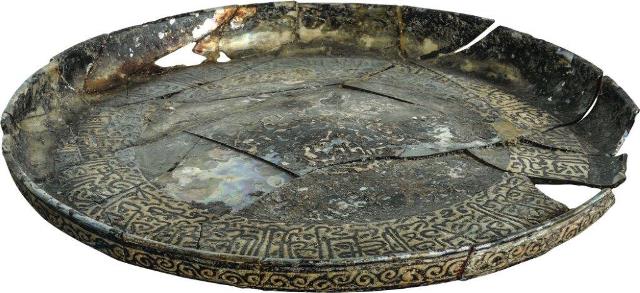
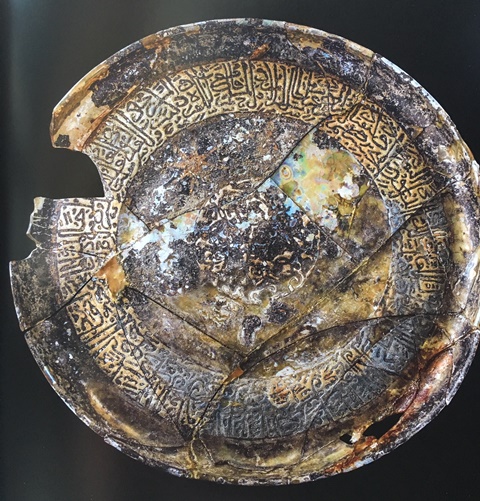
The most important glass object to come down to us from the Seljuk era is the magnificent enameled and gilded honey-colored glass flat platter with an everted rim, found during the excavations at Kubadabad Palace on the shores of Lake Beyşehir during the excavations of the 1965-66 season. and which is now conserved at the Konya Karatay Museum. It measures 30.5cm in diameter and bears an inscription in naskh calligraphy to Sultan Giyaseddin Keyhüsrev II (r. 1237-1246). A central medallion is decorated with foliate patterns painted in gold and various colored enamels. The mention of the name of the sultan has allowed this plate to be dated to his reign, and, as such, is one of the few securely-dated pieces of medieval Islamic enameled glass. It is believed that it was part of a set which included beakers. The plate was most probably manufactured as a royal commission in Ayyubid Syria (Damascus, Aleppo and Raqqa, 1171-1250), famous for its enameled glass production. Another enameled rim fragment, found at Kubadabad in 2012, is encircled by a scroll that is very similar to the large plate.
|
Glass plate This is the most important piece of glassware of the Seljuk era, notable for its size, provenance, shape and enameled decoration, and by the fact that a wide inscription encircles the rim and bears the name and epithets of Sultan Giyaseddin Keyhüsrev, son of Alaeddin Keykubad. However, the inscription does not include a date but no date. It was found at the Kubadabad Palace. This glass plate inspired a scene in the historical novel, Moon Queen. Konya Karatay Museum, inv. 2162 |
|
|
|
|
|
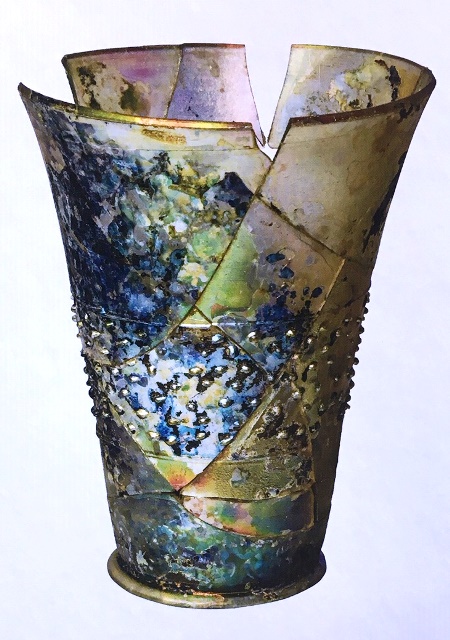
This 13th century glass beaker is of a shape frequently seen in the tiles found at the Kubadabad Palace. It includes raised prunts which offer a firmer grip to the goblet. This beaker and the one to the right are considered to be imports from Raqqa in Syria. Adiyaman Museum, inv. 263; Excavated at Samosata.
|
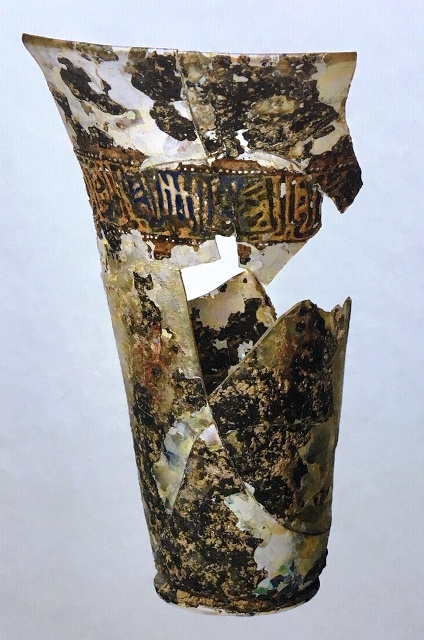
This goblet includes near the top a wide band of kufic calligraphy in gold wash on blue.
Adiyaman Museum, inv. 543; Excavated at Samosata. |
©2001-2026, Katharine Branning; All Rights Reserved.