The Seljuk Han of Anatolia
Seljuk Ceramics
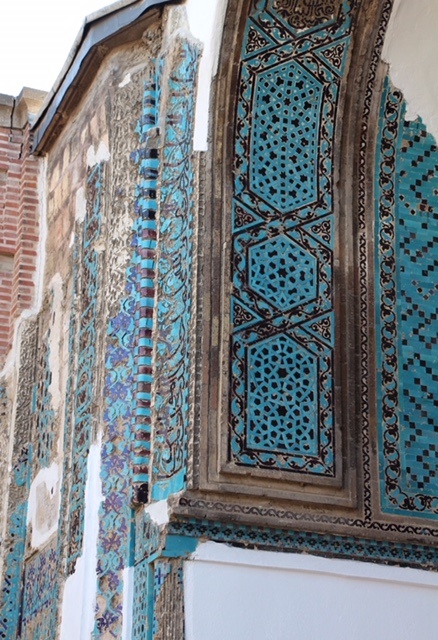
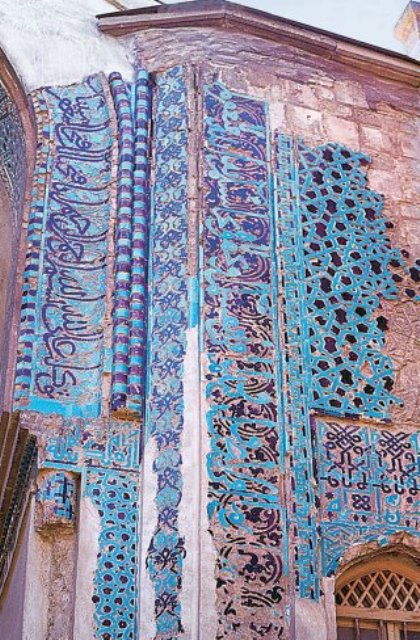
Ceramics are an important decorative complement to Seljuk architecture, especially for mosques, medreses and tombs. Seljuk monuments are memorable for their extensive use of blue ceramic decoration on mihrabs, portals, facades and domes.
Seljuk ceramic art includes 3 types of production:
Monochrome glazed bricks or tiles (used individually or cut up to form mosaic panels)
Figurative underglaze painted tiles
Ceramic vessels and wares
1) Monochrome Glazed bricks and tiles
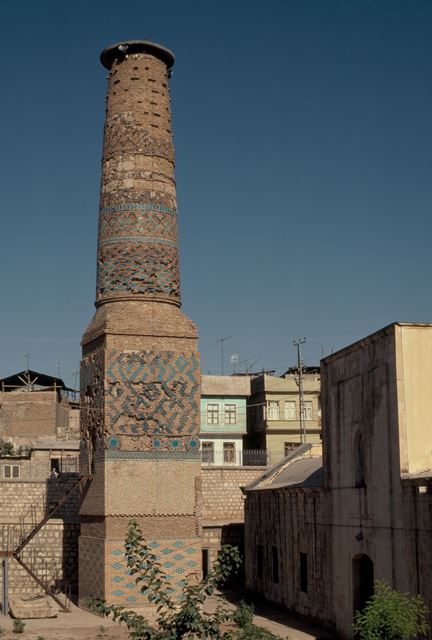
Monochrome glazed bricks and tiles became an important decorative element for the exterior of monuments, especially on minarets.
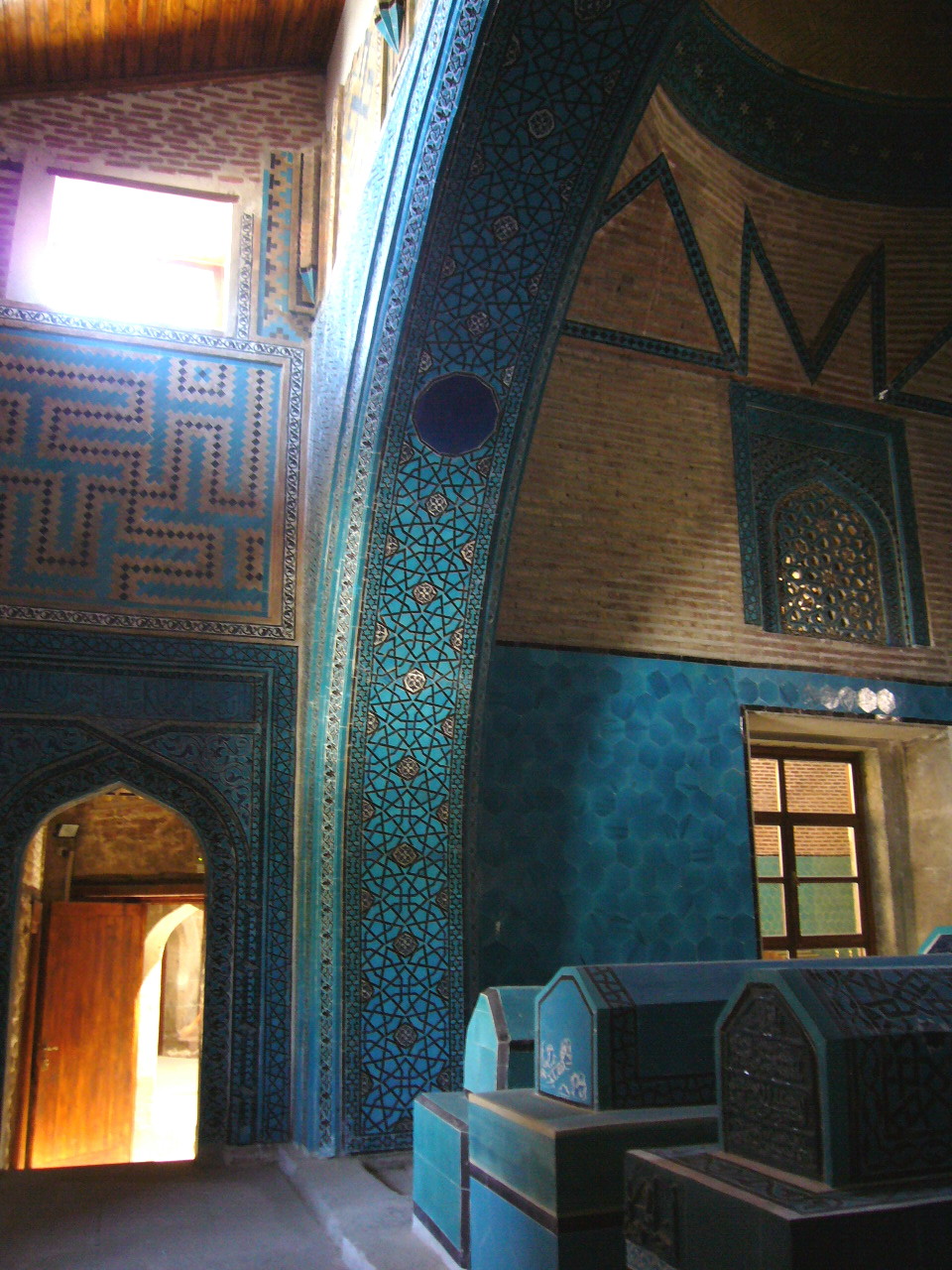
The Seljuks excelled at the complex technique of firing glazed tiles and bricks, and used them with great skill and effect on their monuments, both internally and externally. The addition of the colorful glazed tiles as a decorative complement to the austere tan walls of Seljuk buildings is a successful aesthetic marriage, creating monuments of striking visual beauty.
The colors of the tiles followed a palette of turquoise, cobalt blue, deep purple, black and white, with brown and yellow more rarely employed. Tiles were used extensively to decorate doorway arches, mihrabs, and minarets on all types of Seljuk monuments.
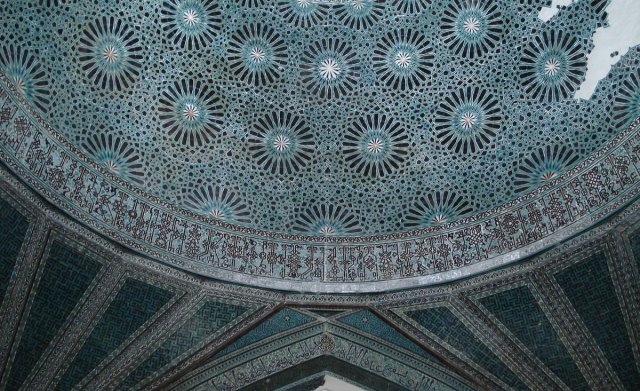
The finest examples of tile work are to be found at Konya. Konya was the first center of tile and glazed brick production in Anatolia, and by the 13th century, its production was exported throughout the Islamic world. The dazzling celestial dome of blue tile at the Karatay Medrese in Konya is an unforgettable masterpiece of decorative art.
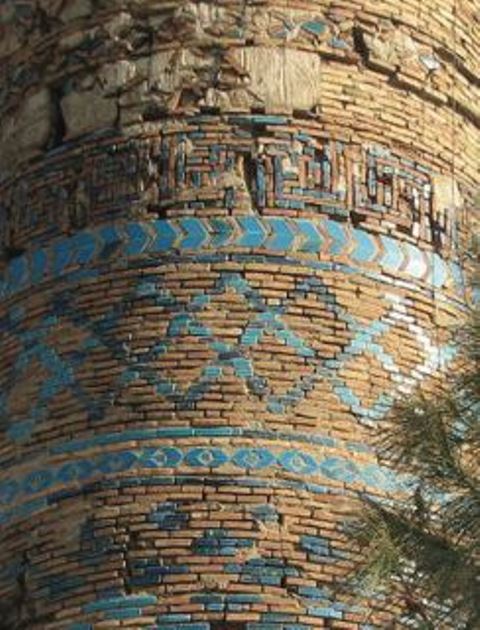
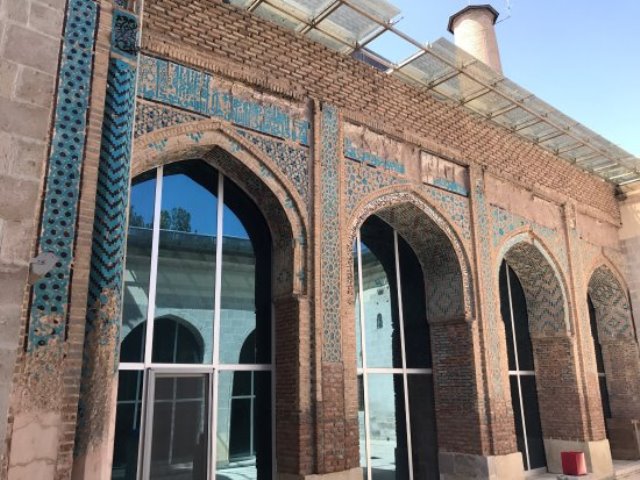
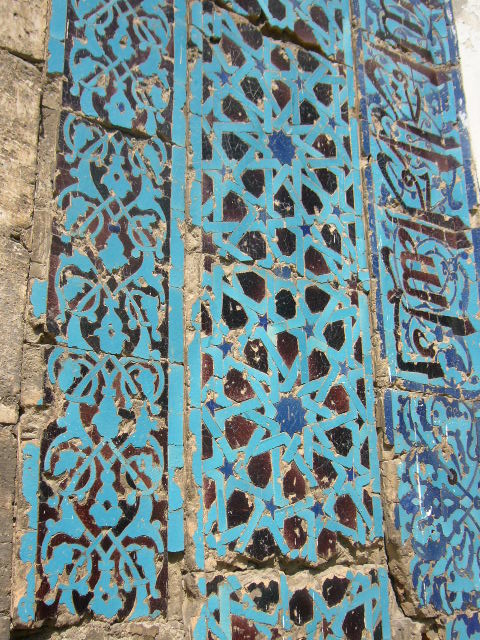
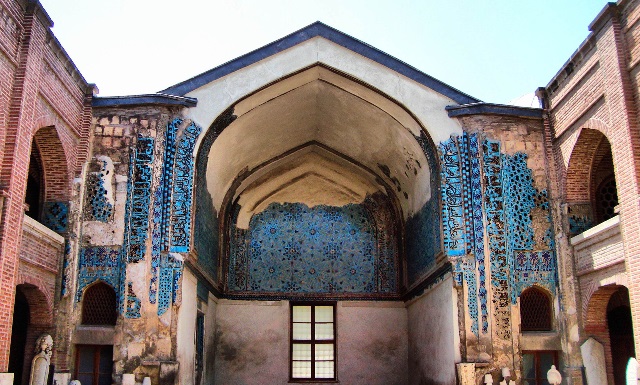
Glazed bricks (Tile Mosaic): The production technique was a simple one, consisting of coating one of the narrow sides of a brick with glaze and then firing it. The glazed bricks could be cut up different shapes or used as is. This so called tile mosaic is thus not a production technique but rather a technique of installation. Of sturdy and durable nature, these bricks were generally turquoise in color, although after the middle of the 13th century, cobalt blue and a darker eggplant color are also seen. The tile mosaic technique could be used to cover both flat and curved surfaces. The design patterns achieved by using these tiles become more complex at this time as well, evolving from plain turquoise bands to geometrical patterns, zigzags and lozenges, with more and more area covered on the minaret. Minarets with glazed tile decoration include the Kayseri Ulu Cami (1205), the Taş Medrese of Akşehir (1250), the Sahipata Mosque in Konya (1258), the Gök Medrese and Çifte Minareli Medrese in Sivas (1272), the Ince Minareli Medrese in Konya (1264) and the Yivli Minare Mosque of Antalya (mid-13th). Aside from minaret decoration, there are a few Seljuk monuments that use glazed bricks for exterior decoration. These include the Izzeddin Keykavus tomb in Sivas (1219-20), the breathtaking Sırçalı Medrese in Konya (1242-43), and the Malatya Ulu Cami.
However, the interiors of monuments, decorated with glazed tiles, are a different story.
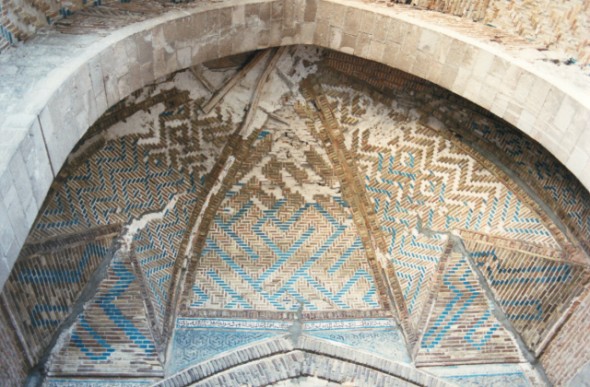
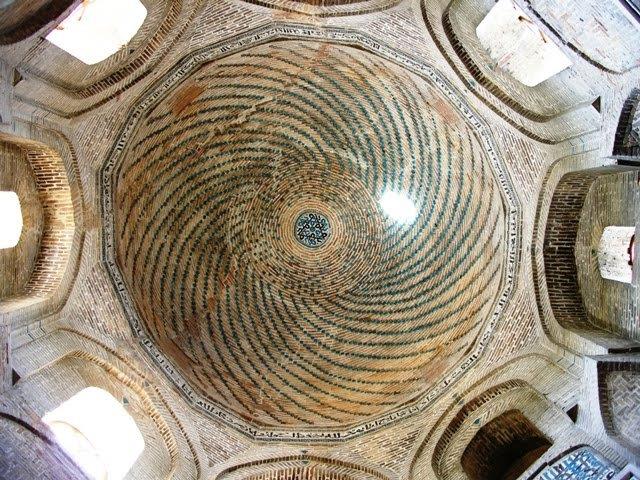
Glazed tiles: This is again a relatively simple technique, where glazes tiles are produced by applying a colorless or colored glaze over a fired brick, and then refiring to fix the glaze. Preferred colors were turquoise, aubergine purple and dark blue. Colors were often combined to form original geometric patterns by using tiles in shapes of squares, rectangles, hexagons, 8-pointed stars, lozenges and bowties. Monochrome glazed tile panels were used to cover the interior walls of Seljuk works, creating a visual riot of colored glazed brick decoration on arches, vaults, iwans, domes and squinches (dome transition elements). Glazed bricks were often used in conjunction with unglazed red bricks to form complex patterns, such as the dome decoration of the Ulu Cami in Malatya (1247).
Plain tiling was also seen on sarcophagi of the Seljuk period, such as on the sarcophagi in the Türbe of Sultan Kılıç Arslan II (1156-1192), located next to the Alaeddin Mosque in Konya.
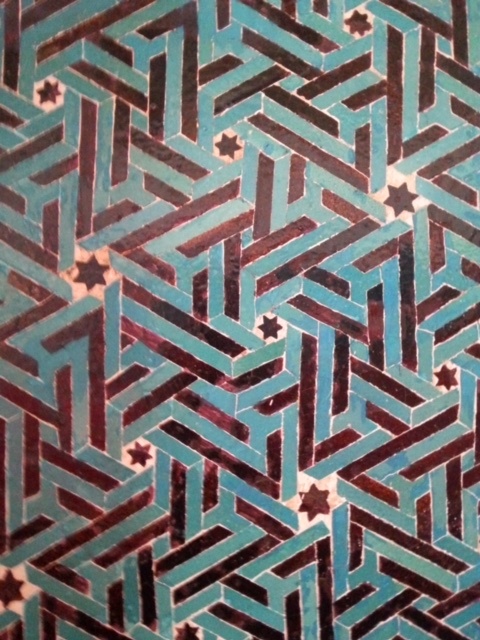
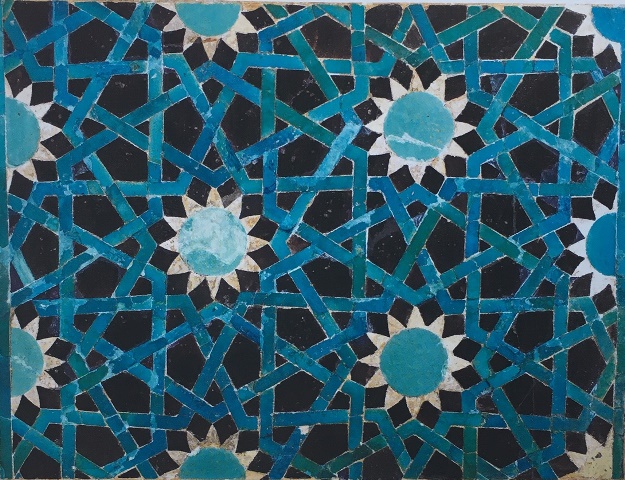
Another important Seljuk decorative technique was the monochrome mosaic tile technique. Monochrome glazed tile panels were cut into pieces and reassembled into geometric, floral and abstract patterns.
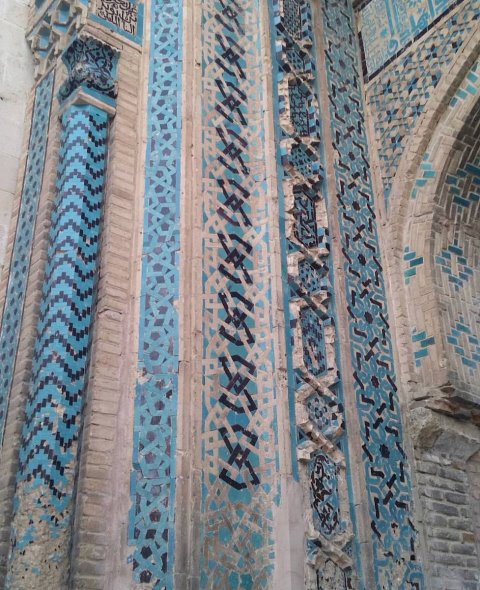
This labor-intensive, but very flexible, technique used cut up tile pieces which were then set like mosaic cubes to form intricate angular patterns of stars, geometric and key patterns, or kufic style script. The tiles were first baked, and then cut into the geometric shape desired. The mosaic bits were laid out to form the desired pattern, and then the reverse side was covered in plaster, which left the inlaid mosaic bits embedded in a panel which could then be attached to the wall or surface. The white of the plaster mortar showed through between the bits, creating a lively contrast with the blue tile pieces.
These smaller mosaic cut tile arrangements could be adapted to cover curved surfaces such as arches, domes and squinches. Large-scale designs were used on doorways and the pendentives of domes, such as at the Karatay Medrese in Konya (1251) and the Taş Medrese in Çay (1278). Together with carved stone, the tile-mosaic decoration formed the basis of Seljuk architectural decoration.
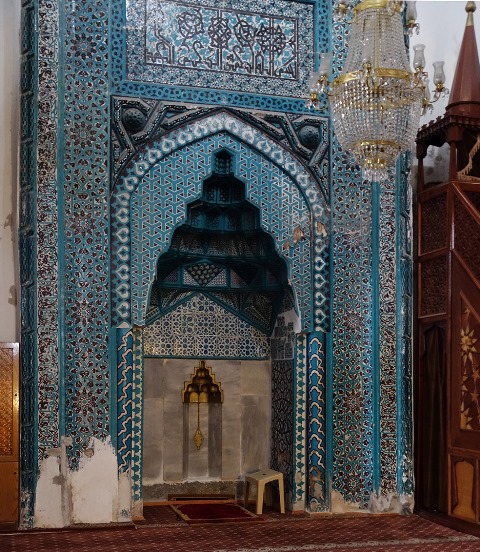
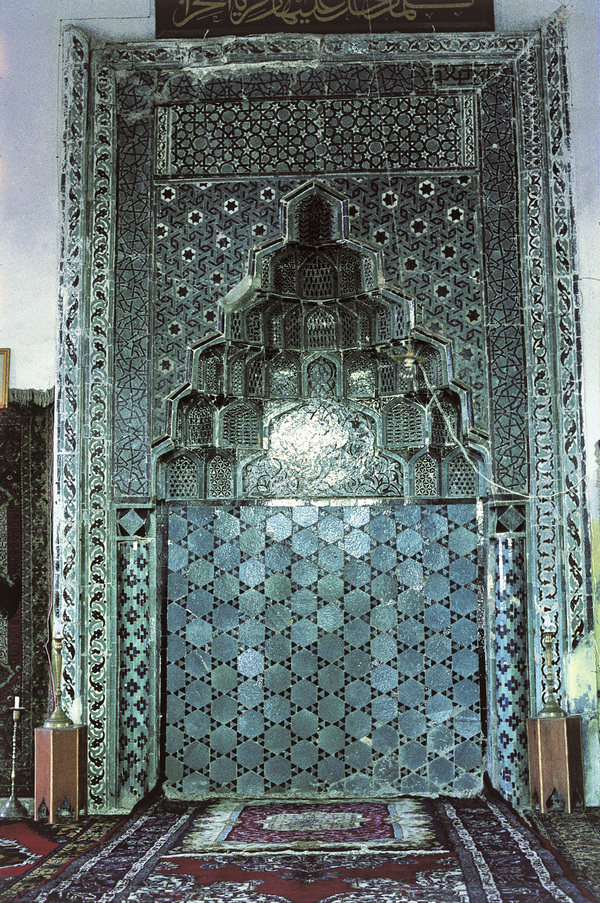
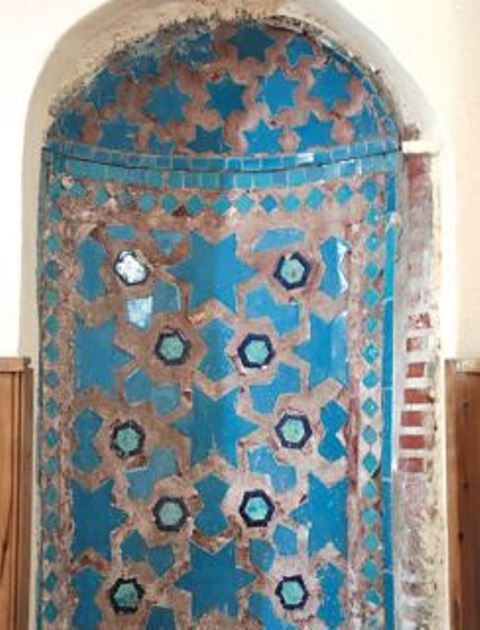
This technique was especially used by the Seljuks to adorn mihrabs. Here the cut-up pieces were set into a distinctive pattern of small honeycomb stalactite niches, known as muqarnas. Famous examples include the mihrabs of the Alaeddin Mosque (1220), the recently-restored Sahip Ata Mosque (1258) and the Sircali Medrese (13th c.), all in Konya. The clay was first shaped into a single honeycomb cell-shaped mold and then fired. The tile was then colored, glazed and baked a second time before setting in place to create the niche.
Tile for fills and borders were created in large plaques and cut as needed. They were principally used to decorate mihrab niches, but were also seen on vaults, domes and squinches.
In the case of hans, ceramic decoration was not extensively employed, which is fitting with the utilitarian profile of these buildings. Tile was used only as decoration for the borders of mihrabs of the kiosk mosques of the Aksaray and Kayseri Sultan hans.
For a list of cities with Seljuk monuments with important programs of ceramic decor, click here.
Mihrab of the Güllük Medrese, Kayseri
Mihrab of the Sahip Ata Mosque, Konya, 1258
Sıırt Ulu Camı Mınaret, 1129
Sıırt Ulu Camı Mınaret, 1129
Malatya Ulu Cami, 1247
Malatya Ulu Cami, 1247
dome of the Malatya Ulu Cami, 1247
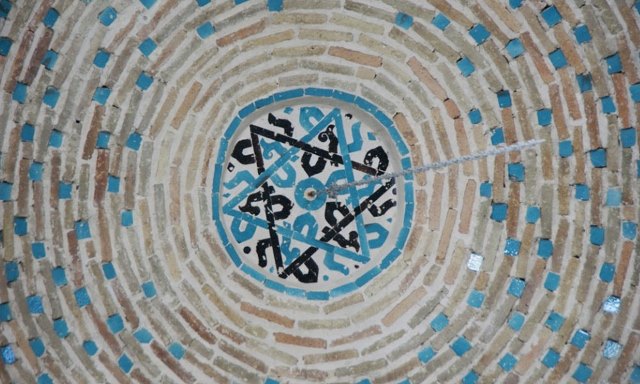
detail of dome, Malatya Ulu Cami, 1247
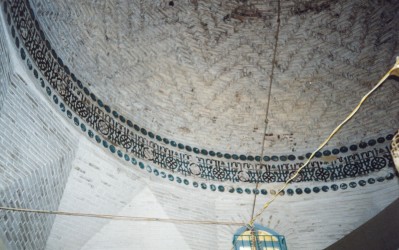
Küçük Aya Sofia Mosque, Akşehir, dome detail; 1235
Konya: Tomb of Sahip Ata, 1283
Konya, Bulgur Tekke, mihrab detail
Tokat, Gök Medrese, 1277
Sircali Medrese Konya; main iwan, 1243
Sircali Medrese Konya; main iwan, 1243
Sircali Medrese Konya; main iwan, 1243
Sıırt Ulu Camı Mihrab, 1129
dome of the Karatay Medrese, Konya, 1251
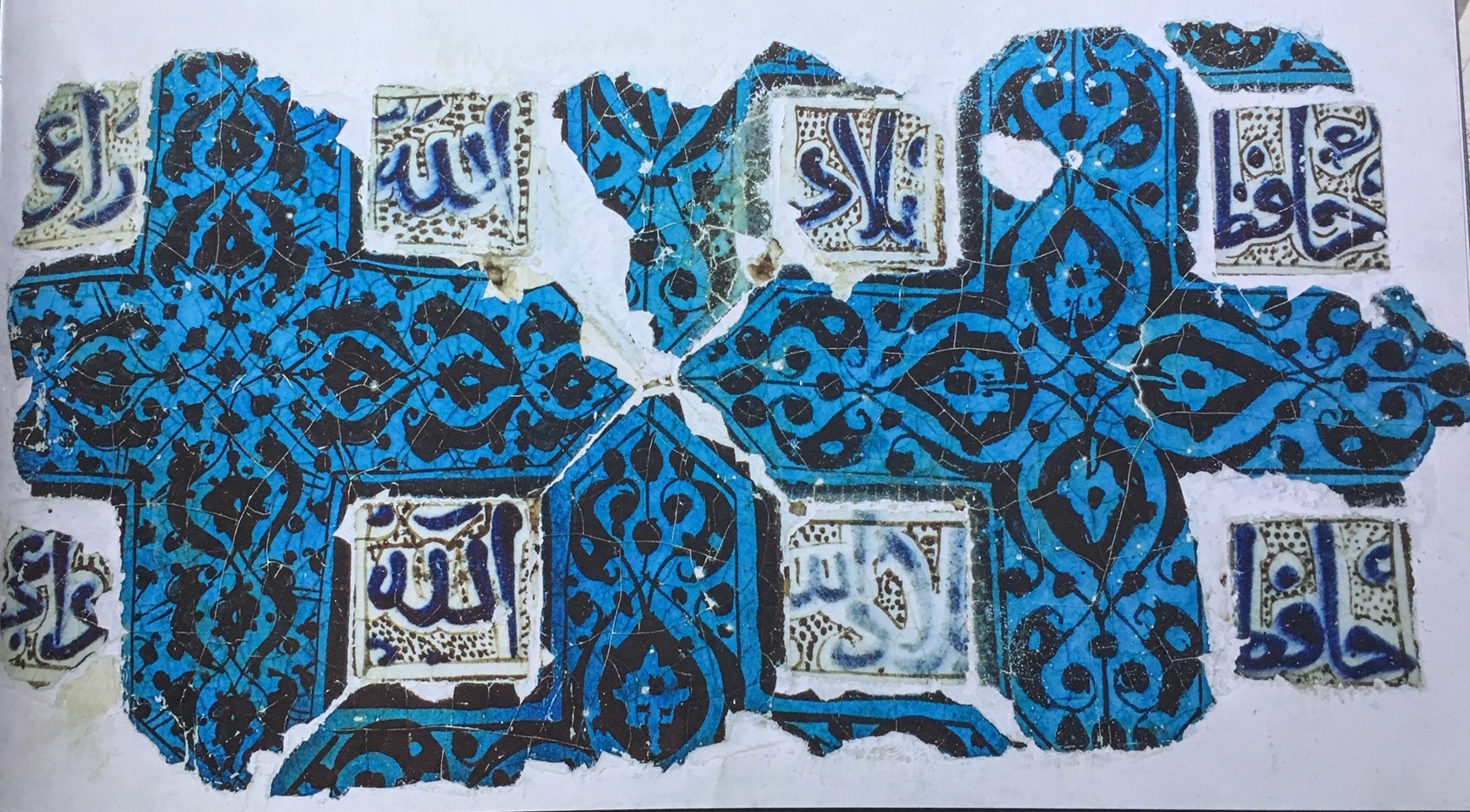
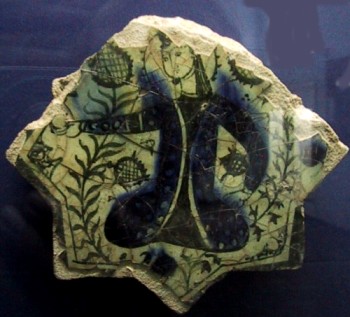
Ceramic mosaic tile fragment, Istanbul Museum of Turkish and Islamic Art, inv. 2436, 13th c.
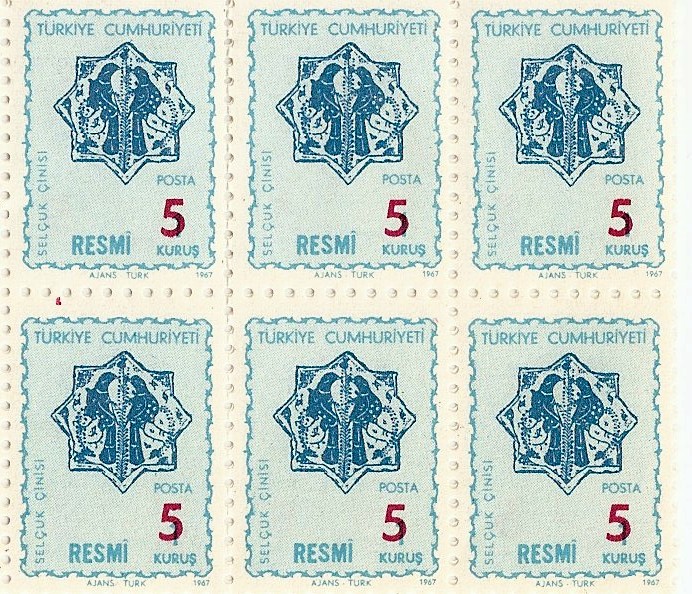
This sophisticated and bright tile from Konya has become the logo of the TIEM Museum
Border tile fragment
Ankara, Ethnography Museum Inv. 11903 13th c.
This section of a running border is a perfect example of the split leaf foliate style known as the rumi.
2) Figurative underglaze painted tiles
However, it can be argued that the glory of Seljuk ceramic production lies in the series of tiles painted with lively figures.
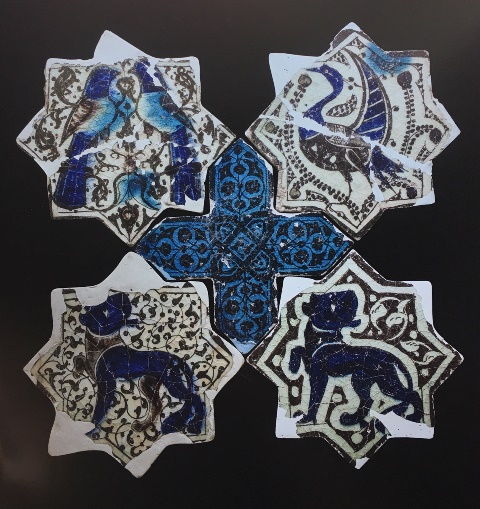
The second major type of tile decoration of the Seljuks involved the use of figurative underglaze painted tiles. Production involved painting a design using heat-resistant paints onto a clay biscuit (once baked) tile. Then a colored or colorless transparent glaze was applied over the design and the tile was refired to set the glaze. Colors for the designs included black, brown, green, blue, turquoise and the beloved aubergine purple. Sometimes the design was silhouetted in black. The tiles were of octagonal or star shape, with the figural decoration in red, gold, black and white, usually on a blue ground. The star shaped tiles (4, 6 or 8 points) are the most frequent, and are generally seen in panels with patterns of 4 star tiles arranged around a cruciform tile of a darker color between them, a sort of frame in reverse. There is no specific thematic pattern in each of the groupings; it would appear they were set in place arbitrarily which created a more lively and interesting appeal.
These tiles were used in the Seljuk palaces, and are of high quality and beauty. They are different than the mosaic style panels in that the tiles are 1) of a different shape (in a distinctive star and cross combination), 2) they depict figural compositions and 3) they are painted in the underglaze technique described above.
And what a repertoire of figures they depict! These tiles show a wide design repertory of lions, bulls, sphinxes, eagles, and women and princes sitting in the traditional Central Asian cross-legged pose, as in the tile which designates the "return to home" hyperlink above. The human figures hold a wide variety of objects in their hands: kerchiefs, pomegranates, goblets, flowers, and even fish. These tiles are joyful, captivating, imaginative, and full of life and movement. Tiles with floral, geometric and calligraphy designs also can be found, but these designs were mostly used as background filler for the figurative tiles. The most exuberant of the tiles depict fauna, with bears, horses, goats, dogs, donkeys and peacocks, and a wide range of water and game birds. Mythical animals such as the sphinx, siren, griffon and dragons are also seen. All provide considerable information about the life of the times.
In viewing the Kubadabad tiles, it can be seen that there were 3 very distinct drawing styles, each of which had to correspong to a specific pottery artist and his atelier. These tiles were painted free-hand by the artist, and, although the subjects may repeat themselves, each and every one of them is unique.
Figurative underglaze tiles were used as decoration at the Kubadabad Palace, the Aspendos Palace, the Huand Hatun Baths in Kayseri (now on display in the Kayseri Ethnography Museum), at the Konya Şekerfuruş Mosque and at the tomb of Izzeddin Keykavus in Sivas.
Gilding sometimes added additional glory to these tiles. Tiles could also be overglaze gilded, although this is rare due to the cost and detail of the work. Gold leaf was cut to the desired decorative pattern and applied with a brush to the the tile, which was refired in a very low temperature kiln to set the leaf in place. Examples were used in the Konya Karatay Medrese, the Sahip Ata Tomb in Konya, at the the Kılıç Arslan II Kiosk in Konya (now on display at the Karatay Museum) and on the Seyyid Mahmud Hayrani Tomb in Akşehir (now on display at the Aksaray Taş Medrese Museum).
In addition to overglaze gilded wares, Seljuk tiles also used the luster technique, in which metallic oxides (copper or silver) were applied after the first glazing and then refired at a lower temperature to deposit the metal on the surface of the tile. This technique, originally used on glass, gives a beautiful shimmer to the tile. This technique was first used with great success by the Abbasids in the 9th century. Tiles with the Persian polychrome overglaze minai technique have also been found at the excavations of the royal pavilion at Konya. The minai technique was an elaborate and costly technique whose application was generally reserved for the tiles adorning palaces and pavilions.
Rare as well are the tiles which were made by the minai technique. Often called the "seven-colors" technique, it uses a wide variety of colors applied over the glaze. The glaze is generally opaque white, turquoise or dark blue and the colors painted on were turquoise, cobalt blue, green, brown, red and white. In rare cases, a gold wash or leaf highlighted the design. Minai tiles can be found on the upper floor of the Kiosk of Kilic Arslan II in Konya (late 12th c.)
The excavations led by the eminent professor Dr. Rüçhan Arik of the summer palace of Alaeddin Keykubad on Lake Beyşehir, the Kubadabad, have revealed an impressive cache of luxury polychrome and minai wall tiles, decorated with jumping and prancing animals (domestic and hunting species), lake birds, human figures (servants as well as elite courtiers, men and women), double-headed eagles, mythical creatures (harpies, gryphons, sphinxes) and scenes from everyday life, such as hunting and falconing parties. The Kubadabad series consists of a panel some 22 stars linked together by tile crosses. This magnificent panel has been reconstituted on a wall of the Konya Karatay Museum. The Kubadabad cache is extremely important, as the figurative element of the tiles provides a window onto the daily life of the period. Similar tiles have been found at other Seljuk palaces at Antalya, Alanya, Aspendos, Akşehir and Kayseri. Although few examples survive, tiles were also used as flooring during the Seljuk era.
Panel of Star Tiles
Istanbul, Çinili Köşk Museum, inv. 41-1539
Excavated at the Kubadabad Palace, First half 13th c.
The panel shows the arrangement of the star tiles around a 4-armed cross tile in its middle. Dogs and birds are surrounded by foliate patterns.
Star Tile
Konya, Karatay Madrasa Tile Museum, inv. 1592
From Kubadabad Palace, Mid 13th c. ; White slip, painted and covered with a transparent glaze
Star Tile Fragment
Konya, Karatay Madrasa Tile Museum, inv. 2425
From Kubadabad Palace, Mid 13th c.
White slip, painted and covered with a transparent glaze
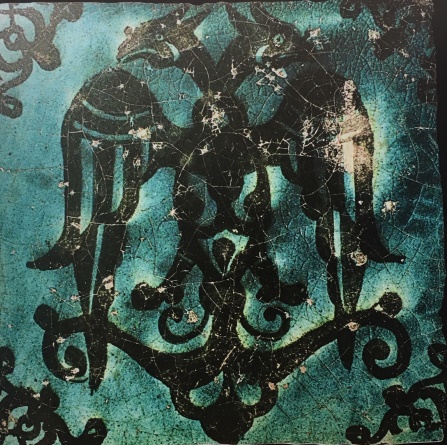
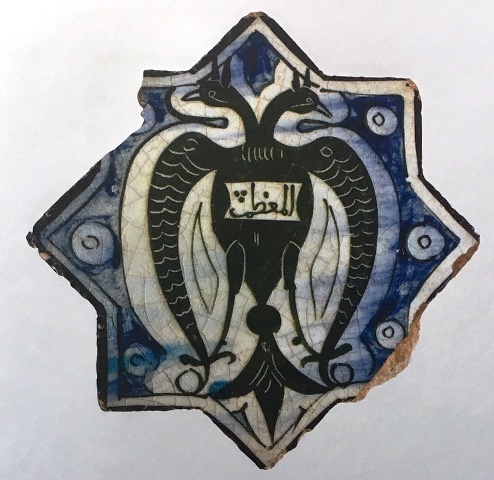
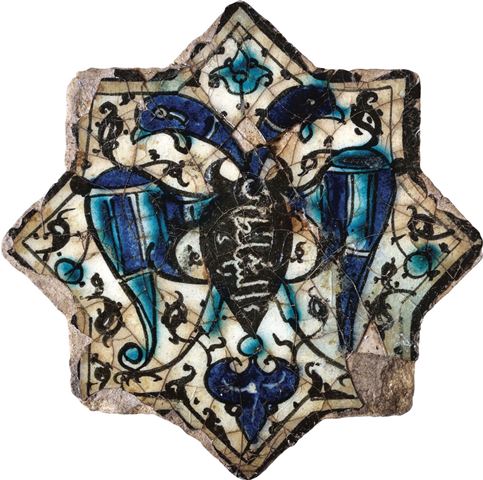
Some of the star tiles bear the double-headed eagle, symbol of the Seljuk sultan, some of which bear inscriptions with his epithets. The framed inscription on the breast of the double-headed eagle reads “al-muazzam”, a frequent epithet of the sultan
Star Tile
Konya, Karatay Madrasa Tile Museum, inv. 1143
From the Kubadabad Palace, End 13th-beg. 14th c.
White slip, painted and covered with a transparent glaze
Behold the Seljuk Sultan al-Sultan, as blazed across the chest of this double-headed eagle.
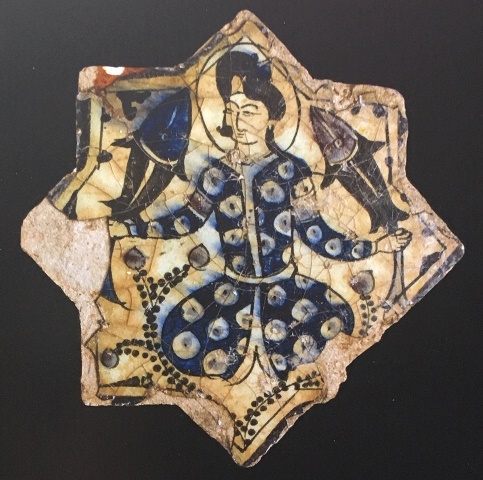
Star Tile Fragment
Konya, Karatay Madrasa Tile Museum, inv. 1067
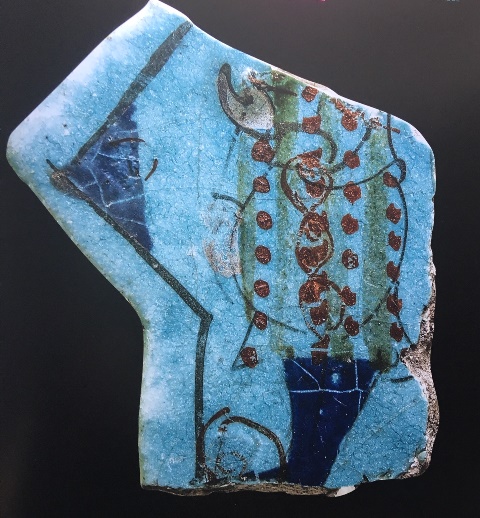
From Kubadabad Palace, Mid 13th c.
White slip, painted and covered with a transparent glaze
This powerful pose no doubt reflects the bounty of fish to be found in Lake Beyşehir at the Kubadabad Palace. The servant wears a patterned caftan with tiraz arm bands
Star Tile
Kayseri Archaeological Museum, inv. 75/665
From the Huand Hatun Baths in Kayseri, 1237/38
The tepedarium room of baths of the Huand Hatun complex in Kayseri contained star tile panels which were the exact same tiles seen in the Kubadabad Palace, and which must have been fired there. The pose here is slightly different than the normally-seen cross-legged one.
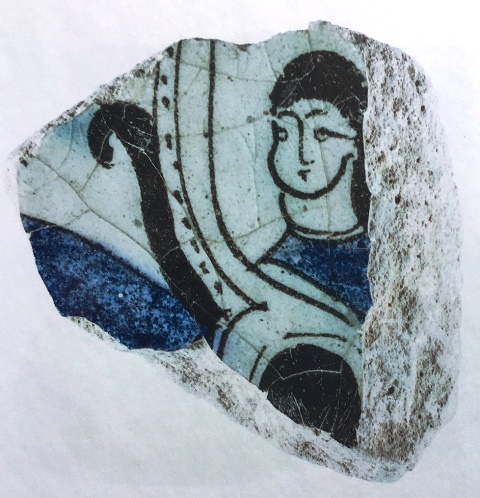
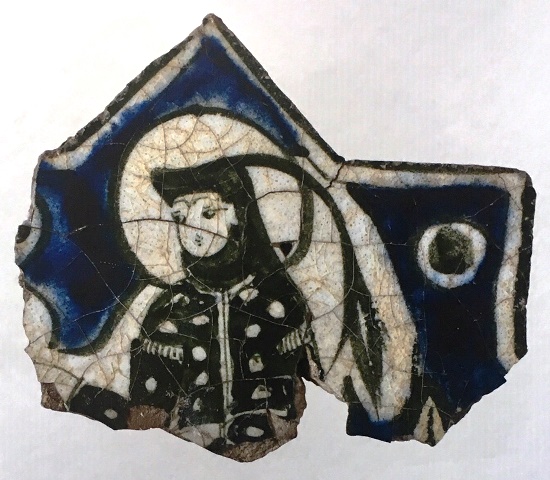
Tile Fragment
Konya, Karatay Madrasa Tile Museum, inv. 1572
From Kubadabad Palace, Mid 13th c.
White slip, painted and covered with a transparent glaze
Seljuk tiles, such as this one, are often valuable resources for studying the clothing styles of the era, and all indicate that women’s faces were always uncovered.
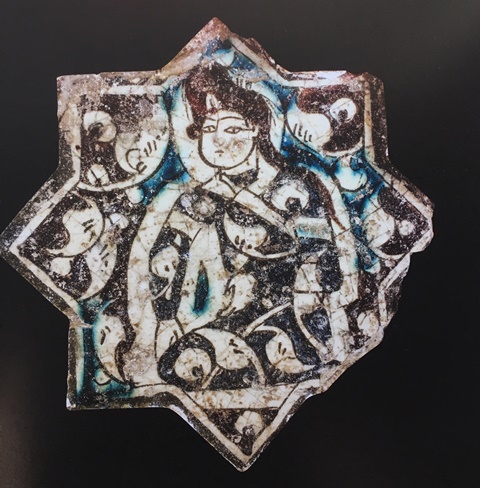
Star Tile Fragment
Konya, Karatay Madrasa Tile Museum, inv. 1549
From Kubadabad Palace, Mid 13th c.
White slip, painted and covered with a transparent glaze
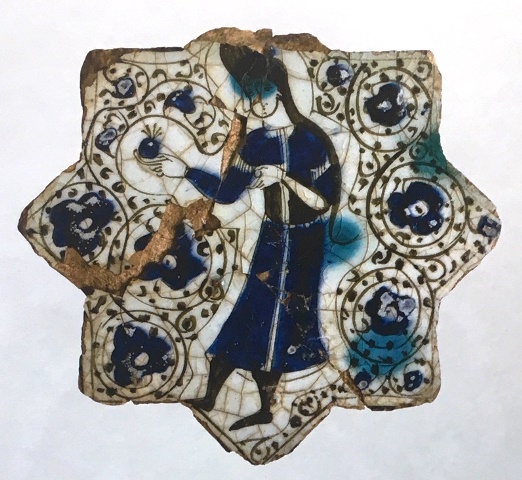
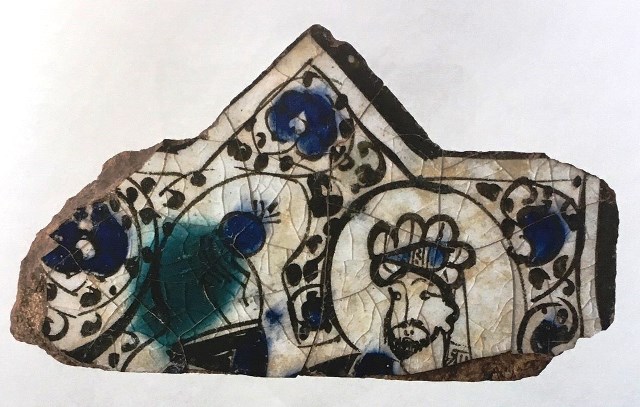
The turban and regal pose of this figure have led art historians to question whether this tile is a portrait of Sultan Alaeddin Keykubad himself.
Star Tile Fragment
Konya, Karatay Madrasa Tile Museum, inv. 3152, Excavated at the Kubadabad Palace; Mid 13th c. White slip, painted and covered with a transparent glaze
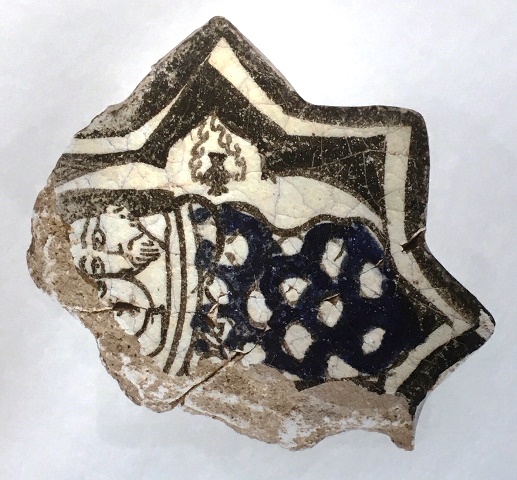
This touching and intimate scene of a couple at repose seems as if lifted from a miniature.
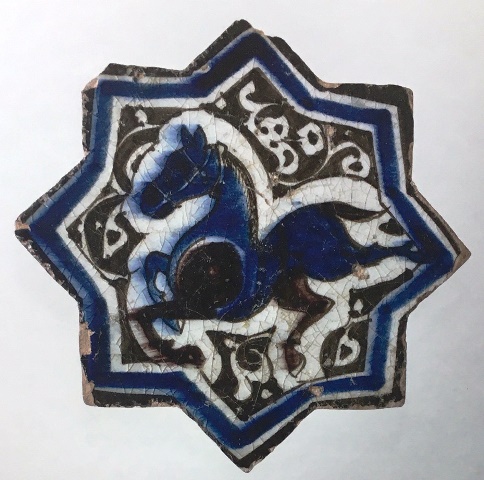
Star Tile
Konya, Karatay Madrasa Tile Museum, inv. 1269, Excavated at the Kubadabad Palace; Mid 13th c. White slip, painted and covered with a transparent glaze
This joyful tile, depicting a spirited horse, is both realistic and abstract at the same time. Of all the hundreds of tiles found at the Kubadabad Palace, this irresistable one is the favorite of the current author.
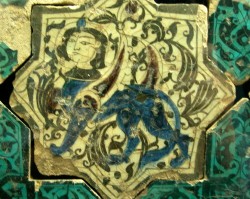
Figurative tile from Kubadabad showing mystical figures
Tile from Kubadabad palace excavations showing the "seated Turkish prince" pose
Star Tile
Konya, Karatay Madrasa Tile Museum, inv. n/a; From Kubadabad Palace, End 13th-beg. 14th c. ,White slip, painted and covered with a transparent glaze
This very same sun figure is seen carved in stone on the façade of the Incir Han.
Tile Fragment
Antalya Museum, inv. n/a, 1st half 13th c.
This underglaze tile fragment was found at the palace built by Sultan Alaeddin Keykubad at the Roman theater of Aspendos. It appears to depict a sphinx.
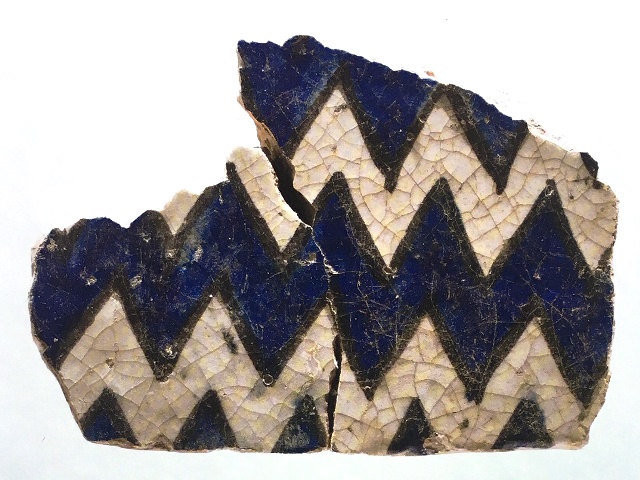
Tile Fragment
Antalya Museum, Inv. 2011/132
1221-1223; Found at the Alanya Palace
This fragment depicts a the two-colored zigzag pattern favored by Sultan Alaeddin Keykubad, and is seen in painted wall decoration (Aspendos and Alanya Palaces) and ceramics (floor tiles at the bath at the Kubadabad Palace).
Tile
Diyarbakir Museum, inv. 5/1/91, From the Diyarbakir Palace
Early 13th c. ; Stonepaste, painted in black with a transparent turquoise glaze
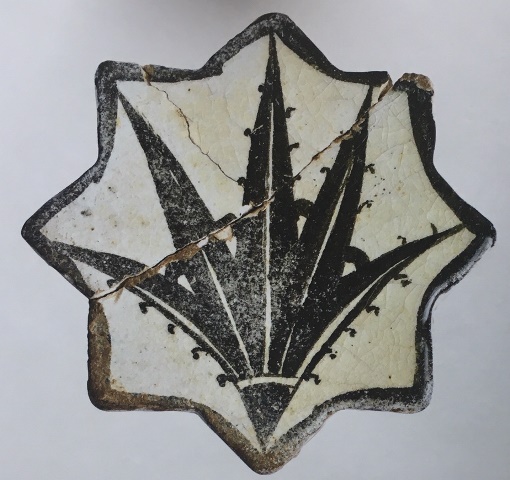
Star Tile
Konya, Karatay Madrasa Tile Museum, inv. 2926, From Kubadabad Palace, Mid 13th c.- beg 14th; White slip, painted and covered with a transparent glaze
This tile has a more abstract design that those done in the middle of the century, so probably dates from a later time.
Star Tile Fragment
Istanbul, Çinili Köşk Museum, inv. 41-1476; From the Kiosk of Kiliç Arslan II, Konya, Second half 12th c.
This tile is an example of the minai technique of painting. It depicts a human figure with the top part of the torso missing.
Tile Panel
Antalya Museum, inv. 2007/7-9, Excavated at the Antalya Palace, 13th c.
3) Ceramic Wares
Ceramic utensils are the basis of utilitarian life, and were found in every lowly home and shop and in every royal palace. They are used for cooking, eating and for storage of foodstuffs and water. They could be plain or fancier, depending on the budget of the owner. However, compared to the tiles, few pottery vessels or ceramic works from the Seljuk period are known, but excavations are currently revealing more insights. Excavations carried out in 1965-66 at Kalehisar near Alacahöyük, Ahlat and Hasankeyif have revealed important information about the ceramics industry of the 13th century. Two kilns were unearthed along with a substantial quantity of kiln material and shards of ceramics decorated with the sgraffito and slip techniques. Other archeological sites for pottery include Eskikahta, Adiyaman (Samsat), Korucutepe near Elaziğ. Examples of these wares may be seen in the Karatay Museum in Konya, The Mevlana Museum in Tokat, and the Çinili Kösk Museum in Istanbul.
There were several types of ceramic wares:
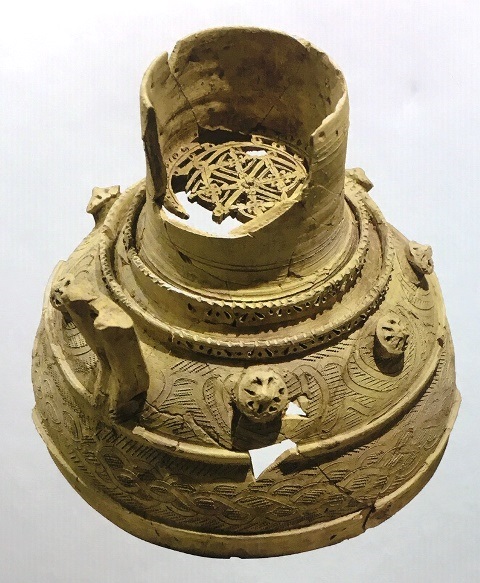
- unglazed earthenware vessels, usually jars, flasks and jugs for everyday household use. Seljuk pottery vessels are somewhat crude and coarse, and exist in the many shapes for everyday tableware use: pitchers, dishes, goblets, flasks, lamps, jars and jugs. They are usually made of reddish or off-white clay with a coarse grain. The vessels were formed free-hand or on the pottery wheel. They could be left plain or decorated by the traditional techniques of stamping, molding, incising or barbotine (slip-painted), and the decoration consisted of human and animal figures and a wide range of floral and geometric designs.
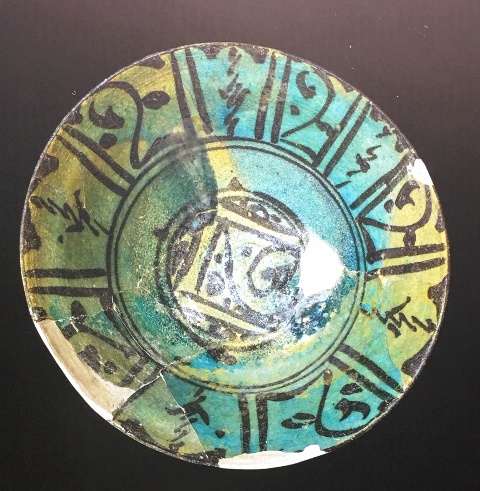
- monochrome glazed wares: the clay is covered with a glaze of shades of green, turquoise (most frequent), yellow or brown. The clay is either red earthenware or a finer stone paste clay. The glazes could be transparent or opaque, smooth and shiny or more rough and grainy. The glazes could be added directly to the clay, or, the object could be first covered with a cream slip (a "prime coat" used to mask the color of the clay) and then covered with the glaze. The colored glaze could cover the entire object (as in bowls) or could partially cover the object, such as for jugs and pitchers. More rarely, the glaze was applied to the interior of the vessel as well. The glaze is thick. Monochrome glazed wares were found both in simple homes and palaces.
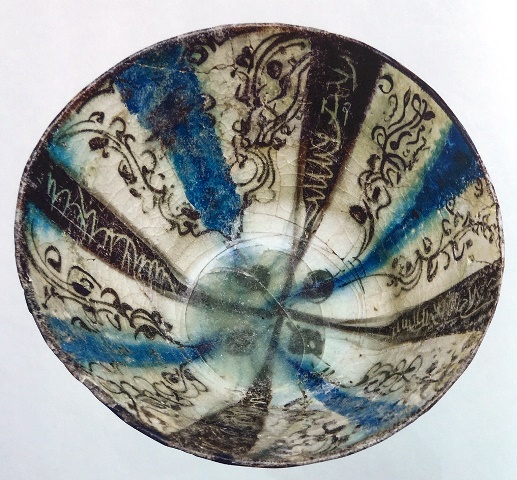
-polychrome glazed wares: the same technique as above; only using a palette of several colors. Most frequently seen are wares with a painted decor of designs in blue or black or under a transparent or monochrome glaze (usually green). Bowls can be decorated with figures, birds, inscriptions and vegetal elements, as seen on the Kubadabad tiles. An interesting fragment of bowl, now housed in the Ankara Ethnography Museum (inv. 17345), depicts the interior of a palace and gives insight to the types of decoration seen in Seljuk palaces.
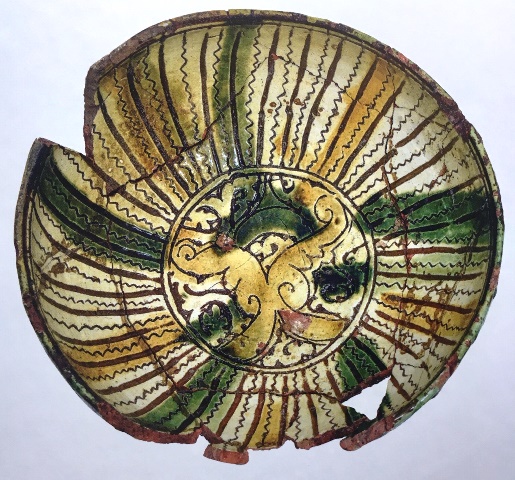
- sgraffito (“scratched”) wares: a technique where the decoration incised in the slip before the glazing and firing. Designs were simple geometric, floral and figural elements. This is a common technique known since the 9th century. A favored color combination was green, white and yellow. This technique was frequently used on bowls.
- Relief ware technique: a simple technique where blobs of clay could be added for relief and design, such as rows of tresses, etc. These additions in relief added not only decoration, but also allowed for a firmer grip
- champlevé technique wares, where the design is incised in deep grooves which are then painted in black and covered with a transparent or green glaze, similar to Syrian Raqqa wares of the 13th century.
- lusterware fragments of bowls have been found at the Kubadabad Palace and in southeastern and eastern Anatolia (Samsat and Ahlat). This luxury ware could have been Iranian imports or made locally. They include purple, cobalt blue or brownish metallic glazes. Similar to the tiles made with the same technique, these bowl are often decorated with animal and bird figures with a background of vegetal and calligraphic elements.
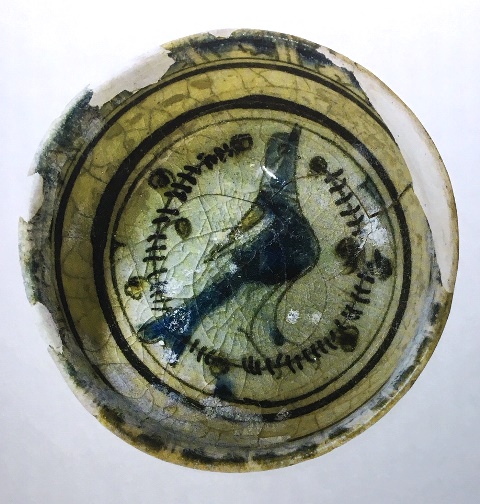
Ceramic Bowl
Adiyaman Museum, inv. 2270, Excavated at Samosata, 13th c.
This bowl in stonepaste is covered with a cream slip and painted in black, blue and green paint and then covered with a transparent glaze. It depicts a central bird surrounded by a wreath of poppy or pomegranate blossoms.
Glazed ceramic bowl
Karatay Museum, Konya, 12-13th c.
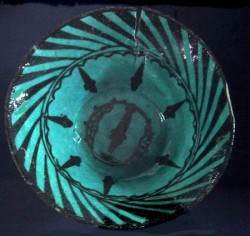
Ceramic Bowl
Adiyaman Museum, inv. 1566; Excavated at Samosata, 13th c.
This simple bowl with a large flared rim is made of stonepaste covered with a cream slip, painted in black and covered with a transparent turquoise glaze. This black paint imitates calligraphy but is approximate and may have been done by a Greek or Armenian potter who did not know Arabic.
Barbotine Jar
Ankara, Museum of Anatolian Civilizations, inv. n/a, 12-13th c.
An elaborately-decorated jug for liquids, complete with strainer filter.
Bowl
Kayseri, Museum of Seljuk Civilization, inv. SUM-52, 12-13th c.
Stoneware with the underglaze technique common in the Seljuk era, decorated with a dramatic striped pattern infilled with tendrils.
Bowl
Erzurum Museum, inv. 2009-26; Excavated at the Citadel of Erzurum, 13th c.
This bowl uses the sgraffiato technique which was a frequent decorative technique for Seljuk ceramics.
Jug
Ankara, Ethnography Museum, inv. 25717, 13th c.
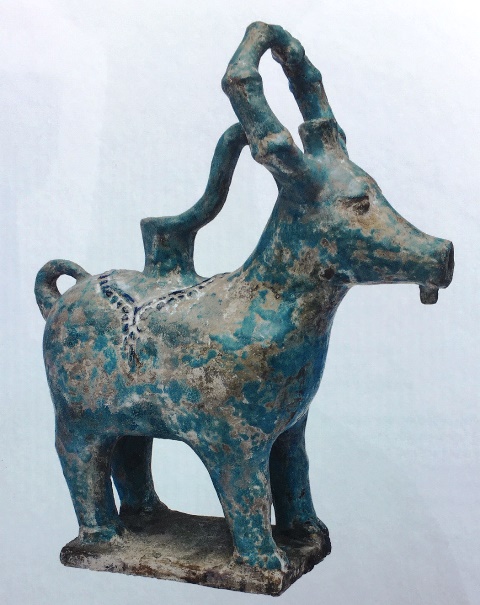
This cheerful jug is in the shape of a ram, whose horns link with the handle. It is covered with a transparent turquoise glaze.
It is certain, however, that the Seljuks preferred to focus their ceramic production on the tiles used to decorate buildings, and not to develop a luxury ceramic ware production, as was the case in Iran.
To learn more about the world of Seljuk ceramics, please consult the work by Dr. Rüçhan Arik (cf. Treasures of the Anatolian Soil on the bibliography page.)
Please see this poem to the ceramic arts of the Seljuks by the Kayseri poet Muhsin Ilyas Subaşi.

.jpg)